
How to Choose a SCADA System Integrator for PLC Upgrades and Plant Connectivity
Publication Date
author
Why does choosing a SCADA system integrator matter so much during a PLC upgrade?
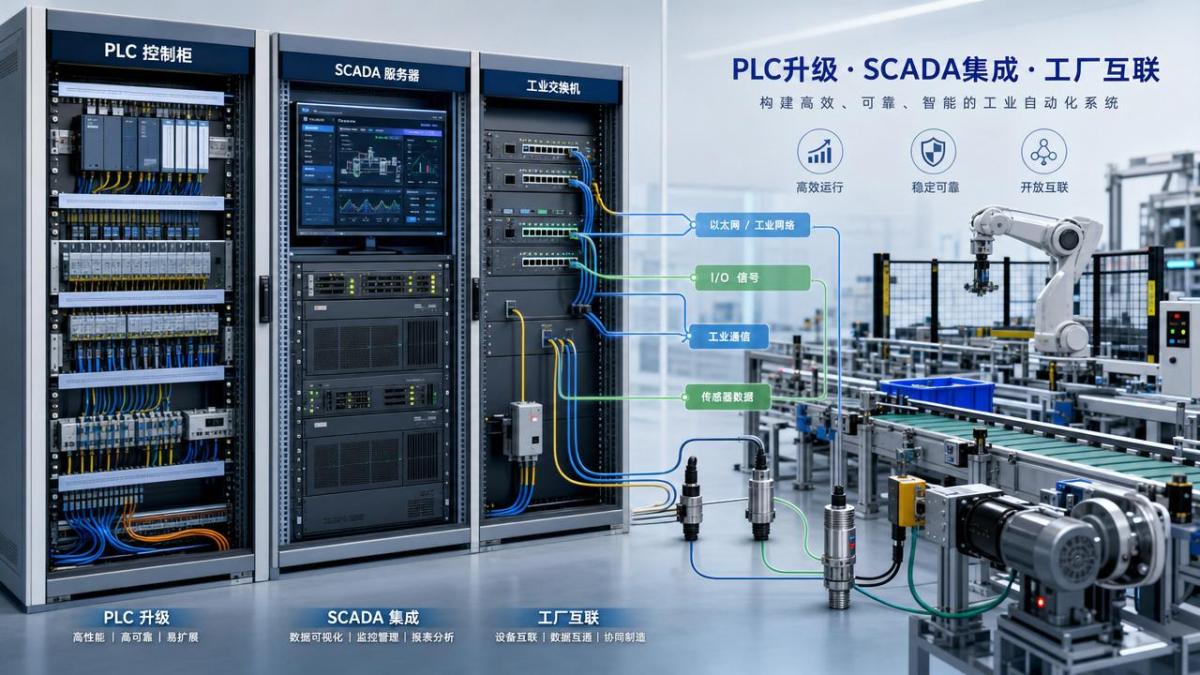
A PLC upgrade is rarely just a hardware refresh.
It often changes data flow, alarm logic, historian structure, network traffic, and operator visibility across the plant.
That is why the right scada system integrator can influence uptime long after commissioning ends.
In practice, the real question is not who can install software fastest.
The better question is who can connect legacy PLCs, modern controls, and plant data without creating hidden risk.
This matters across general industry because mixed equipment environments are common.
A facility may run older Allen-Bradley or Siemens controllers beside newer IIoT gateways, vision systems, and MES links.
A capable scada system integrator understands that connectivity is only valuable when signals are mapped correctly, timestamps stay reliable, and operators trust the screens.
This is also where a data-first mindset helps.
TechStat Vanguard consistently argues that engineering decisions should be anchored in measurable parameters, not promotional language.
That principle fits SCADA selection well.
You need evidence on protocol depth, validation methods, cyber controls, and migration discipline.
What should a SCADA system integrator actually be able to do?
Many firms say they handle integration, but their capabilities vary widely.
A dependable scada system integrator should cover more than HMI design and tag import.
They should be able to review control architecture, PLC migration paths, network segmentation, and downstream data consumers.
They also need a working understanding of production constraints.
For example, a packaging line, water treatment skid, machining cell, or warehouse conveyor system may each require different cutover logic.
A strong team usually brings competence in several areas:
- PLC platform migration, including I/O validation and sequence testing.
- SCADA graphics, alarm rationalization, historian structure, and recipe or batch links.
- Industrial protocols such as OPC UA, Modbus TCP, Profinet, EtherNet/IP, and serial conversion layers.
- Secure remote access, user permissions, patch planning, and backup recovery procedures.
- Site acceptance testing, rollback planning, and post-startup support.
If a vendor only speaks about dashboards, be cautious.
The best scada system integrator treats the project as an operational system, not a software license deployment.
How can you tell whether an integrator understands legacy equipment and plant connectivity?
This is often where selection mistakes appear.
A polished proposal may look convincing, yet fail once old drives, undocumented tags, or unstable serial devices enter the picture.
A practical scada system integrator should ask detailed questions early.
They should want controller models, firmware versions, network drawings, alarm history, and a list of external systems already consuming data.
A useful way to evaluate fit is to compare what they ask, not just what they claim.
In real projects, these details reveal maturity fast.
A scada system integrator with deep plant connectivity experience usually talks about constraints before benefits.
Where do cybersecurity and data integrity enter the decision?
They should enter at the start, not after the graphics are approved.
Any PLC upgrade that expands plant connectivity also expands the attack surface.
That includes remote support channels, historian servers, engineering workstations, and cloud or enterprise data links.
A qualified scada system integrator should be comfortable discussing ISA/IEC 62443 principles, account control, network zones, and backup integrity.
Just as important, they should know which protections are realistic for an operating site with legacy assets.
The same goes for data accuracy.
Bad timestamps, duplicated tags, poor alarm thresholds, or dropped packets can quietly damage production decisions.
That is why TSV’s broader philosophy matters here.
Engineering truth depends on trusted parameters.
If a new SCADA layer cannot produce reliable plant data, the upgrade may add visibility without adding truth.
Ask for specific examples of cyber hardening, historian validation, and disaster recovery testing.
Vague promises are not enough in connected industrial environments.
What are the most common selection mistakes when comparing a SCADA system integrator?
The most common mistake is comparing only price and delivery dates.
A low bid can become expensive if commissioning slips, alarm floods increase, or production reporting breaks after cutover.
Another mistake is assuming PLC expertise automatically means SCADA expertise.
The reverse is also true.
A team may build attractive screens but struggle with controller migration, buffering, or deterministic communications.
Other risks are less obvious, but still costly:
- No clear ownership of tag naming, alarm philosophy, or historian schema.
- No written migration sequence for live production assets.
- Limited documentation handover after startup.
- Support model depends on one individual rather than a stable team.
- Success criteria focus on installation completion, not operational performance.
A more balanced comparison looks at technical depth, risk ownership, validation discipline, and maintainability over five to ten years.
That approach usually gives a better result than chasing the fastest quote.
How should you compare proposals, cost, and implementation timelines?
Start by separating visible cost from lifecycle cost.
The proposal from a scada system integrator should explain engineering hours, software scope, field commissioning, training, and support boundaries.
If those items are blended into a single total, comparison becomes difficult.
Implementation timing should also be broken into real milestones.
Useful milestones include discovery, design freeze, FAT, site cutover, SAT, and stabilization support.
A short timeline is not always a strong timeline.
If the site has many legacy PLCs or external reporting links, compressed schedules often push risk into startup.
When comparing bidders, this checklist helps:
- Confirm which PLC families and firmware revisions are included.
- Ask whether historian, alarm, recipe, and ERP or MES interfaces are in scope.
- Check whether testing is simulated only or includes field I/O verification.
- Review post-go-live support hours and escalation paths.
- Verify documentation deliverables, backups, and source code ownership.
This is often where the better scada system integrator stands out.
They make assumptions visible, quantify boundaries, and reduce ambiguity before the purchase order is issued.
What is a sensible next step before making the final choice?
Begin with a short internal specification, even if it is not perfect.
List existing PLC platforms, required uptime windows, cybersecurity constraints, reporting needs, and critical operator functions.
Then ask each scada system integrator to respond against the same criteria.
That simple step makes proposals easier to compare and exposes missing assumptions early.
It also aligns with the TSV view that procurement quality improves when decisions are driven by parameters, traceability, and technical evidence.
If two options still look close, request a workshop focused on one real production area.
Ask how the integrator would migrate that area, validate tags, secure access, and recover from rollback conditions.
The strongest answer usually sounds practical rather than promotional.
In the end, choosing a scada system integrator is really about deciding who can convert plant data into dependable operations.
When the evaluation is structured around evidence, constraints, and long-term maintainability, PLC upgrades are far more likely to deliver visibility, resilience, and scalable connectivity.
Search News
Hot Articles
- Carbon Fiber StructuresHow to Specify Aerospace Carbon Fiber Assemblies for Lightweight, Load-Bearing PartsJul 11, 2026
- Machine VisionXiaomi, Alibaba DAMO Academy Drive Open-Source Robotics Model Ecosystem, Lowering Algorithm Development Barriers for Overseas SMEs Adopting Chinese Robotics SolutionsMar 30, 2026
- Cobots & ArmsShanxi 'AI+' Conference Showcases Embodied Intelligence with Multinational Buyer Engagement: Key Industry ImplicationsMar 30, 2026
Popular Tags
Recommended News
 Jul 11, 2026How to Specify Aerospace Carbon Fiber Assemblies for Lightweight, Load-Bearing PartsAerospace carbon fiber assemblies: learn how to specify laminate design, load data, joining methods, and inspection controls for lighter, reliable load-bearing aerospace parts.Elena Rostova (UAV Systems Researcher)
 Mar 30, 2026Xiaomi, Alibaba DAMO Academy Drive Open-Source Robotics Model Ecosystem, Lowering Algorithm Development Barriers for Overseas SMEs Adopting Chinese Robotics SolutionsXiaomi & Alibaba DAMO Academy's open-source robotics models lower algorithm barriers for global SMEs. Boost efficiency in manufacturing, logistics & smart retail with ROS 2 compatible solutions.TSV Data Lab
 Mar 30, 2026Shanxi 'AI+' Conference Showcases Embodied Intelligence with Multinational Buyer Engagement: Key Industry ImplicationsShanxi 'AI+' Conference highlights embodied intelligence with Tesla, Ubtech & Jiantao showcasing multimodal robotics. 40+ global buyers validated tech on-site, creating new B2B channels for industrial automation & AI solutions.Chen Wei (Automation Lead Engineer)
 Mar 30, 2026Zhongguancun Unveils 6G Integrated Sensing-Computing-Intelligence Platform to Empower Embodied Robots for Global Industrial ApplicationsZhongguancun's new 6G platform revolutionizes industrial robotics with <10ms latency, empowering global automotive, logistics & port automation. Discover how this tech boosts China's smart manufacturing exports.TSV Data Lab
 Mar 30, 2026Mech-Mind Tianjin Embodied Intelligence R&D and Production Base Goes Live, Cutting Delivery Time by 20%–30% for Global Customized AMR+Vision SolutionsMech-Mind's Tianjin AMR+Vision production base cuts delivery time by 20%-30% for欧美 & Latin American markets. Discover how this PLd-certified facility accelerates customized robotics solutions for smart manufacturing and logistics.Chen Wei (Automation Lead Engineer)
 Mar 30, 2026Boao Forum Reveals 'Co-evolution of Big and Small Brains' Trend in Humanoid Robots, China's Embodied Intelligence Accelerates Adaptation to Overseas Manufacturing Service ScenariosDiscover how China's humanoid robots, featuring 'Co-evolution of Big and Small Brains,' are revolutionizing global manufacturing. Learn about Embodied Tian Gong 3.0's ISO compliance and overseas deployment at Boao Forum 2026.Chen Wei (Automation Lead Engineer)
 Mar 30, 2026China Railway Industrial Secures Patent for Embodied Robotics in Material Handling, Boosting High-Precision Delivery Capabilities for Overseas Infrastructure and Manufacturing ProjectsChina Railway Industrial's new patent for embodied robotics in material handling boosts high-precision delivery for global infrastructure & manufacturing. Discover how this innovation enhances logistics accuracy in automotive, rail transit & EPC projects.Chen Wei (Automation Lead Engineer)
 Oct 25, 2026Hesai Leads Global ADAS Main Lidar Shipments in Yole’s 2026 ReportHesai led global ADAS main lidar shipments with a 43% share in 2025, according to Yole’s 2026 report. Explore what this ranking reveals about its automotive market position.TSV Data Lab
 Oct 25, 2026Choosing an Aerospace Materials Manufacturer: Quality and Traceability ChecksChoosing an aerospace materials manufacturer? Learn how to verify certifications, test reports, and lot traceability to qualify suppliers confidently and reduce costly sourcing risks.Dr. Marcus Vance
 Oct 24, 2026Guotai Haitong: Global Entry-Level 3D Printer Shipments Rose 39% in Q1 2026Entry-level 3D printer shipments rose 39% in Q1 2026, Guotai Haitong reports. Explore how AI, multicolor printing and print farms are shaping market growth.Dr. Marcus Vance
 Oct 24, 2026Choosing an Industrial Vision Inspection Supplier: Acceptance Tests That MatterChoose an industrial vision inspection supplier with confidence. Discover acceptance tests for defect detection, false rejects, production speed, and reliable part rejection before you buy.TSV Data Lab
 Oct 23, 2026US Navy Raises Gecko Robotics Contract Ceiling to $300M for Robotic Fleet MaintenanceUS Navy raises Gecko Robotics’ contract ceiling to $300M for Pacific Fleet robotic inspections. Explore potential opportunities for maintenance suppliers and key procurement considerations.Chen Wei (Automation Lead Engineer)
 Oct 23, 2026Choosing Industrial Sensing Systems for Global Plants: Protocol CompatibilityCompare industrial sensing systems international buyers can trust. Explore protocol compatibility, reduce integration risks, and select proven configurations for reliable global plant deployments.TSV Data Lab
 Oct 22, 2026KUKA Showcases Physical AI and iiQKA.AI Vision at NVIDIA GTC BerlinExplore KUKA’s Physical AI showcase at NVIDIA GTC Berlin and discover how iiQKA.AI Vision aims to simplify robotic vision integration and improve 2D and 3D scene recognition.TSV Data Lab
 Oct 22, 2026Robotic Machining of Advanced Composites: What Tolerances Are Achievable?Explore advanced materials machining robotics: discover what drives achievable composite tolerances and how to validate accuracy before investing in your next machining system.Dr. Marcus Vance
 Oct 21, 2026China’s Industrial Robot Exports Near RMB 10 Billion in First Nine Months of 2026China’s industrial robot exports neared RMB 10 billion in January–September 2026, with value rising faster than volume. Explore the data and what it could mean for suppliers.Chen Wei (Automation Lead Engineer)
 Oct 21, 2026Low-Latency Industrial Data Processing: Pricing and Key Cost DriversExplore industrial data latency price drivers, from edge hardware to integration and support. Learn how to compare quotes, verify performance, and avoid unnecessary costs.TSV Data Lab
 Oct 20, 2026KUKA Launches iiQKA.AI Vision to Simplify Industrial Image ProcessingKUKA iiQKA.AI Vision simplifies industrial image processing with controller-based 2D and 3D vision. Explore drag-and-drop setup for vision-guided automation.TSV Data Lab
 Oct 20, 2026Smart Industrial Edge Devices: Key Criteria for Legacy PLC IntegrationChoose smart industrial edge devices for legacy PLC integration. Discover key criteria for compatibility, data quality, security, and reliable collection without disrupting control.TSV Data Lab
 Oct 19, 2026Choosing a Radar Sensor by Application: Range, Resolution, and Field of ViewSimplify radar sensor application based product selection. Compare range, resolution, and field of view to avoid blind spots and choose with confidence. Explore the guide.TSV Data Lab
 Oct 18, 2026Comparing Material Options for Procurement: Specs, Costs, and Supply RisksExplore procurement oriented technical content on material options, specs, costs, and supply risks. Compare alternatives to cut hidden expenses and make confident sourcing decisions.Dr. Marcus Vance
 Oct 17, 20265-Axis CNC Positioning Accuracy: How to Interpret ISO 230-2 Test ResultsAssess 5 axis CNC machining positioning accuracy with ISO 230-2. Learn to interpret repeatability, reversal error, and test conditions to compare suppliers and make confident acceptance decisions.Dr. Marcus Vance
 Oct 16, 2026Choosing a Rugged Edge AI Box Supplier: Thermal Tests and Lifecycle SupportChoose a rugged edge AI box supplier with proven thermal performance and reliable lifecycle support. Discover the tests and commitments to verify before you buy.TSV Data Lab
 Oct 15, 2026R&D Cost Reduction Services: How to Evaluate Fees, Savings, and ROIEvaluate R&D cost reduction services with confidence. Compare fees, verify savings, and calculate ROI without compromising performance. Discover how to choose a provider that delivers real value.Chen Wei (Automation Lead Engineer)























