How MES Production Reporting Improves OEE, Traceability, and Shop Floor Decisions
Publication Date
author
Why does MES production reporting matter to decision-makers, not just plant supervisors?
Because it changes the quality of decisions above the shop floor.
Most factories already have machines generating data, operators recording output, and ERP systems tracking orders. The problem is that these signals often live in separate places, arrive late, or get translated into spreadsheets after the fact. By the time management sees the report, the shift is over, the bottleneck has moved, and the reason for the loss is already blurred.
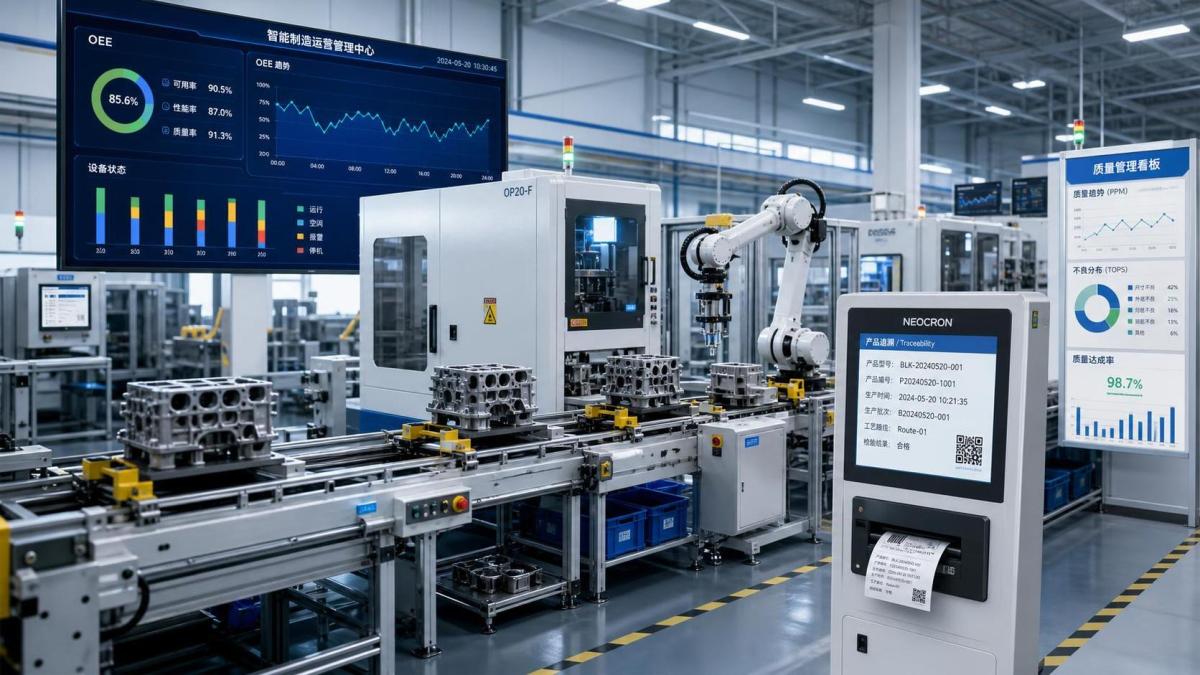
MES production reporting closes that gap. It collects production events where they happen, structures them by order, machine, operator, material, and time, and turns them into something leadership can actually use: current output versus plan, downtime by reason, scrap by operation, WIP status, and traceable production history. For an enterprise decision-maker, that means fewer assumptions and less arguing over whose number is correct.
This is especially relevant in complex environments where compliance, quality containment, and delivery commitments all depend on fast, defensible operational visibility.
What exactly is MES production reporting?
At a practical level, it is the reporting layer of a Manufacturing Execution System that turns raw production activity into usable operational records and performance views.
That usually includes:
- actual quantities produced, accepted, reworked, or scrapped
- machine run time, idle time, changeover time, and downtime reasons
- labor activity by station, line, or order
- material consumption and lot usage
- process timestamps for start, pause, completion, and transfer
- electronic production records tied to specific batches, units, or serial numbers
It is not just a dashboard. Good reporting depends on disciplined event capture, consistent reason codes, and a clear production data model. Without those, the charts may look modern, but the decisions built on them will still be weak.
Where does it improve OEE in a way that management can actually act on?
OEE becomes useful when it stops being a single score and starts exposing which loss is happening, where, and under what conditions.
MES production reporting helps by breaking OEE into its operational causes:
The difference is timing. If the system shows that a line misses target because changeovers consistently overrun on one product family, that points to a specific intervention. If management only sees end-of-week output totals, the response becomes guesswork.
Can MES production reporting really strengthen traceability, or does it just create more records?
It strengthens traceability only when records are tied to the product flow, not stored as disconnected logs.
For traceability, the key question is simple: can you reliably reconstruct what happened to a specific batch, unit, or serial number? A useful MES report should let you trace backward to material lots, tooling, process steps, and inspection results, and forward to where affected product went next.
That matters in routine quality investigations, not only in regulated sectors. When a defect appears, leadership needs to know the scope fast. Was it one machine for one hour? One operator on one shift? One incoming lot across three orders? Without structured production reporting, containment often becomes broader than necessary, which means extra scrap, delayed shipments, and avoidable customer exposure.
What shop floor decisions get better first?
Usually the first gains show up in daily execution, not in strategy decks.
With reliable MES production reporting, teams can make faster calls on:
- whether a line is truly constrained by labor, machine uptime, material, or setup loss
- which order should be prioritized to protect delivery performance
- when WIP is building in front of a bottleneck instead of flowing through it
- whether scrap is isolated or trending across a broader process condition
- when a maintenance stop should be escalated instead of repeatedly reset
These are not glamorous decisions, but they shape output, lead time, and customer performance every day. A reporting system earns trust when supervisors and managers use it to settle those questions quickly and consistently.
If a factory already has ERP and machine data, what is still missing?
Usually, context.
ERP knows what should happen: order quantities, due dates, routings, inventory transactions. Machines know what they are doing at a signal level: running, stopped, cycling, alarming. What is often missing is the production truth in between. Which order was actually on the machine? Was the stop planned or unplanned? Was output good, reworked, or scrapped? Which material lot was consumed during that run?
MES production reporting sits in that middle layer. It connects plan to execution and raw machine state to business meaning. Without that layer, organizations often end up with impressive data volume and poor operational clarity.
What should an executive look for to judge whether the reporting is actually trustworthy?
Do not start with dashboard appearance. Start with data discipline.
A trustworthy setup usually shows four things:
- Clear event definitions. Everyone knows what counts as runtime, downtime, setup, scrap, and rework.
- Controlled reason codes. Operators are not choosing from vague or overlapping categories.
- Reconciliation between systems. Reported production should align with order completion, inventory movement, and quality records within a defined review process.
- Low manual backfilling. When large parts of the report are entered long after the shift, accuracy usually drops.
One practical test is to take a recent production issue and ask whether the system can reconstruct the timeline without relying on memory. If the answer still depends on who was on shift, the reporting layer is not mature enough yet.
What are the most common mistakes when companies roll this out?
The biggest mistake is treating MES production reporting as a reporting project instead of an execution-control project.
A few failure patterns show up repeatedly:
- Too many KPIs at launch, with weak capture quality underneath
- Downtime categories designed for management language rather than operator use
- No agreement on the source of truth for quantities and timestamps
- Assuming machine connectivity alone will explain productivity loss
- Skipping governance for master data such as routings, work centers, and product definitions
When this happens, the system may still generate reports, but they do not survive challenge. Once plant teams stop trusting the numbers, adoption drops fast.
How much detail is enough for a first phase?
Less than many teams think.
For an awareness-stage decision, the right question is not “How much can the system capture?” but “What minimum set of production facts would let us improve decisions this quarter?” In many plants, the first phase should focus on a narrow operational spine:
- actual versus planned output by line or work center
- downtime with usable reason codes
- scrap and rework by operation
- basic lot or serial traceability through key process steps
That is often enough to expose chronic losses and containment gaps. Granularity can expand later, especially where quality risk, customer requirements, or product complexity justify it.
Is MES production reporting only worth it in highly regulated or high-mix industries?
No. The value shows up anywhere production variability has financial consequences.
Highly regulated sectors feel the traceability benefit sooner, because record quality directly affects compliance and investigation speed. High-mix operations often feel the scheduling and visibility benefit sooner, because product changes make manual reporting fragile. Repetitive manufacturing can still benefit significantly when small availability and performance losses compound across volume.
A simple decision rule works well: if missed output, unclear downtime, or weak genealogy regularly forces people to escalate based on partial information, MES production reporting is already relevant.
What questions should leadership ask before approving investment?
Three questions usually separate a serious initiative from a software shopping exercise.
- Which decisions are currently delayed or distorted because production data arrives late, conflicts across systems, or lacks traceability?
- Which production events must be captured at the moment they occur, rather than reconstructed later?
- Which metrics will trigger action, and who owns that action at shift, plant, and enterprise levels?
If those questions cannot be answered, the reporting design is still too abstract. If they can, the scope becomes clearer, and so does the likely return: less blind time, faster root-cause isolation, tighter production control, and fewer decisions made on stale summaries.
What is the right way to think about it from the boardroom?
Treat MES production reporting as decision infrastructure.
Its value is not in producing more charts. Its value is in making OEE losses explainable, traceability usable, and shop floor decisions less dependent on delay, memory, and informal workarounds. For enterprise leaders, that is the real test: when operations drift, quality escapes, or delivery risk rises, can the organization see the problem early enough and clearly enough to act with confidence?
If the answer is no, start by defining the few production facts that must be trusted every shift. That is usually where MES production reporting begins to pay for itself.
Search News
Hot Articles
- Carbon Fiber StructuresHow to Specify Aerospace Carbon Fiber Assemblies for Lightweight, Load-Bearing PartsJul 11, 2026
- Machine VisionXiaomi, Alibaba DAMO Academy Drive Open-Source Robotics Model Ecosystem, Lowering Algorithm Development Barriers for Overseas SMEs Adopting Chinese Robotics SolutionsMar 30, 2026
- Cobots & ArmsShanxi 'AI+' Conference Showcases Embodied Intelligence with Multinational Buyer Engagement: Key Industry ImplicationsMar 30, 2026
Popular Tags
Recommended News
 Jul 11, 2026How to Specify Aerospace Carbon Fiber Assemblies for Lightweight, Load-Bearing PartsAerospace carbon fiber assemblies: learn how to specify laminate design, load data, joining methods, and inspection controls for lighter, reliable load-bearing aerospace parts.Elena Rostova (UAV Systems Researcher)
 Mar 30, 2026Xiaomi, Alibaba DAMO Academy Drive Open-Source Robotics Model Ecosystem, Lowering Algorithm Development Barriers for Overseas SMEs Adopting Chinese Robotics SolutionsXiaomi & Alibaba DAMO Academy's open-source robotics models lower algorithm barriers for global SMEs. Boost efficiency in manufacturing, logistics & smart retail with ROS 2 compatible solutions.TSV Data Lab
 Mar 30, 2026Shanxi 'AI+' Conference Showcases Embodied Intelligence with Multinational Buyer Engagement: Key Industry ImplicationsShanxi 'AI+' Conference highlights embodied intelligence with Tesla, Ubtech & Jiantao showcasing multimodal robotics. 40+ global buyers validated tech on-site, creating new B2B channels for industrial automation & AI solutions.Chen Wei (Automation Lead Engineer)
 Mar 30, 2026Zhongguancun Unveils 6G Integrated Sensing-Computing-Intelligence Platform to Empower Embodied Robots for Global Industrial ApplicationsZhongguancun's new 6G platform revolutionizes industrial robotics with <10ms latency, empowering global automotive, logistics & port automation. Discover how this tech boosts China's smart manufacturing exports.TSV Data Lab
 Mar 30, 2026Mech-Mind Tianjin Embodied Intelligence R&D and Production Base Goes Live, Cutting Delivery Time by 20%–30% for Global Customized AMR+Vision SolutionsMech-Mind's Tianjin AMR+Vision production base cuts delivery time by 20%-30% for欧美 & Latin American markets. Discover how this PLd-certified facility accelerates customized robotics solutions for smart manufacturing and logistics.Chen Wei (Automation Lead Engineer)
 Mar 30, 2026Boao Forum Reveals 'Co-evolution of Big and Small Brains' Trend in Humanoid Robots, China's Embodied Intelligence Accelerates Adaptation to Overseas Manufacturing Service ScenariosDiscover how China's humanoid robots, featuring 'Co-evolution of Big and Small Brains,' are revolutionizing global manufacturing. Learn about Embodied Tian Gong 3.0's ISO compliance and overseas deployment at Boao Forum 2026.Chen Wei (Automation Lead Engineer)
 Mar 30, 2026China Railway Industrial Secures Patent for Embodied Robotics in Material Handling, Boosting High-Precision Delivery Capabilities for Overseas Infrastructure and Manufacturing ProjectsChina Railway Industrial's new patent for embodied robotics in material handling boosts high-precision delivery for global infrastructure & manufacturing. Discover how this innovation enhances logistics accuracy in automotive, rail transit & EPC projects.Chen Wei (Automation Lead Engineer)
 Oct 29, 2026Aerospace Aluminum Alloy Strength: 2024-T3 vs. 7075-T6 ComparedCompare aerospace aluminum alloy strength in 2024-T3 vs. 7075-T6. Explore fatigue, corrosion, and weight trade-offs to choose the right alloy for your design.Dr. Marcus Vance
 Oct 28, 2026IDC: Global Quadruped Robot Shipments Rise 92.5% in H1 2026 as Volume and Value DivergeGlobal quadruped robot shipments rose 92.5% in H1 2026, according to IDC. Explore what diverging volume and value trends mean for industrial buyers and manufacturers.Chen Wei (Automation Lead Engineer)
 Oct 28, 2026Interpreting Industrial IoT Latency Data for Monitoring and Real-Time ControlInterpret industrial category latency data to assess jitter, deadline misses, and real-time readiness. Learn how to benchmark IIoT systems and choose monitoring and control solutions.TSV Data Lab
 Oct 27, 2026GXO and Agility Robotics Expand Partnership to Accelerate US Humanoid Robot DeploymentGXO and Agility Robotics plan to expand US humanoid robot deployment with Digit 4 in early 2027. Explore warehouse automation plans, service terms and future Digit 5 upgrades.Chen Wei (Automation Lead Engineer)
 Oct 27, 2026Robotic Automation Costs: Budgeting for Equipment, Integration, and MaintenancePlan your robotics automation cost with confidence. Explore equipment, integration, and maintenance expenses, compare quotes, and build a realistic budget for better ROI.Chen Wei (Automation Lead Engineer)
 Oct 26, 2026AMAXiMAL Releases Open-Source TopMod 3D v3 With Claude AIExplore AMAXiMAL’s free, open-source TopMod 3D v3 with Claude AI assistance, topology-based modeling and plywood fabrication tools that connect complex designs to physical builds.Dr. Marcus Vance
 Oct 26, 2026Choosing a SCADA System Integrator Company: PLC Compatibility and Long-Term SupportChoose a scada system integrator company with proven PLC compatibility and reliable long-term support. Discover what to test, compare, and require before investing.Victor Lin (Chief Software Architect)
 Oct 25, 2026Hesai Leads Global ADAS Main Lidar Shipments in Yole’s 2026 ReportHesai led global ADAS main lidar shipments with a 43% share in 2025, according to Yole’s 2026 report. Explore what this ranking reveals about its automotive market position.TSV Data Lab
 Oct 25, 2026Choosing an Aerospace Materials Manufacturer: Quality and Traceability ChecksChoosing an aerospace materials manufacturer? Learn how to verify certifications, test reports, and lot traceability to qualify suppliers confidently and reduce costly sourcing risks.Dr. Marcus Vance
 Oct 24, 2026Guotai Haitong: Global Entry-Level 3D Printer Shipments Rose 39% in Q1 2026Entry-level 3D printer shipments rose 39% in Q1 2026, Guotai Haitong reports. Explore how AI, multicolor printing and print farms are shaping market growth.Dr. Marcus Vance
 Oct 24, 2026Choosing an Industrial Vision Inspection Supplier: Acceptance Tests That MatterChoose an industrial vision inspection supplier with confidence. Discover acceptance tests for defect detection, false rejects, production speed, and reliable part rejection before you buy.TSV Data Lab
 Oct 23, 2026US Navy Raises Gecko Robotics Contract Ceiling to $300M for Robotic Fleet MaintenanceUS Navy raises Gecko Robotics’ contract ceiling to $300M for Pacific Fleet robotic inspections. Explore potential opportunities for maintenance suppliers and key procurement considerations.Chen Wei (Automation Lead Engineer)
 Oct 23, 2026Choosing Industrial Sensing Systems for Global Plants: Protocol CompatibilityCompare industrial sensing systems international buyers can trust. Explore protocol compatibility, reduce integration risks, and select proven configurations for reliable global plant deployments.TSV Data Lab
 Oct 22, 2026KUKA Showcases Physical AI and iiQKA.AI Vision at NVIDIA GTC BerlinExplore KUKA’s Physical AI showcase at NVIDIA GTC Berlin and discover how iiQKA.AI Vision aims to simplify robotic vision integration and improve 2D and 3D scene recognition.TSV Data Lab
 Oct 22, 2026Robotic Machining of Advanced Composites: What Tolerances Are Achievable?Explore advanced materials machining robotics: discover what drives achievable composite tolerances and how to validate accuracy before investing in your next machining system.Dr. Marcus Vance
 Oct 21, 2026China’s Industrial Robot Exports Near RMB 10 Billion in First Nine Months of 2026China’s industrial robot exports neared RMB 10 billion in January–September 2026, with value rising faster than volume. Explore the data and what it could mean for suppliers.Chen Wei (Automation Lead Engineer)
 Oct 21, 2026Low-Latency Industrial Data Processing: Pricing and Key Cost DriversExplore industrial data latency price drivers, from edge hardware to integration and support. Learn how to compare quotes, verify performance, and avoid unnecessary costs.TSV Data Lab