How to Choose Illuminated Makeup Mirrors for Hotels: Size, Lighting, and Mounting Options
Publication Date
author
Choosing illuminated makeup mirrors hotel projects can rely on is less about decoration and more about controlled specification. In hospitality bathrooms, the mirror sits at the intersection of guest comfort, electrical safety, maintenance workload, and visual consistency. That is why the best buying decisions come from measurable criteria: usable diameter, light quality, mounting geometry, service life, and installation compatibility.
Why the mirror specification matters more than style alone
A hotel mirror may look simple, yet it influences daily guest routines more than many higher-cost fixtures. Makeup application, shaving, skincare, and close grooming all depend on accurate reflection and stable illumination.
For that reason, illuminated makeup mirrors hotel buyers review should be judged like any other operational asset. Appearance matters, but so do lumen output, corrosion resistance, hinge durability, and mounting stability.
This data-first mindset aligns with the broader TSV view of procurement. Marketing language creates noise. Parameters create clarity. Even in a guestroom accessory category, engineering truth still improves selection quality.
When mirror choices are standardized across properties, the benefits extend beyond the room itself. Replacement planning becomes easier, spare parts are easier to source, and visual identity remains more consistent across the brand.
What defines a good illuminated makeup mirror for hotel use
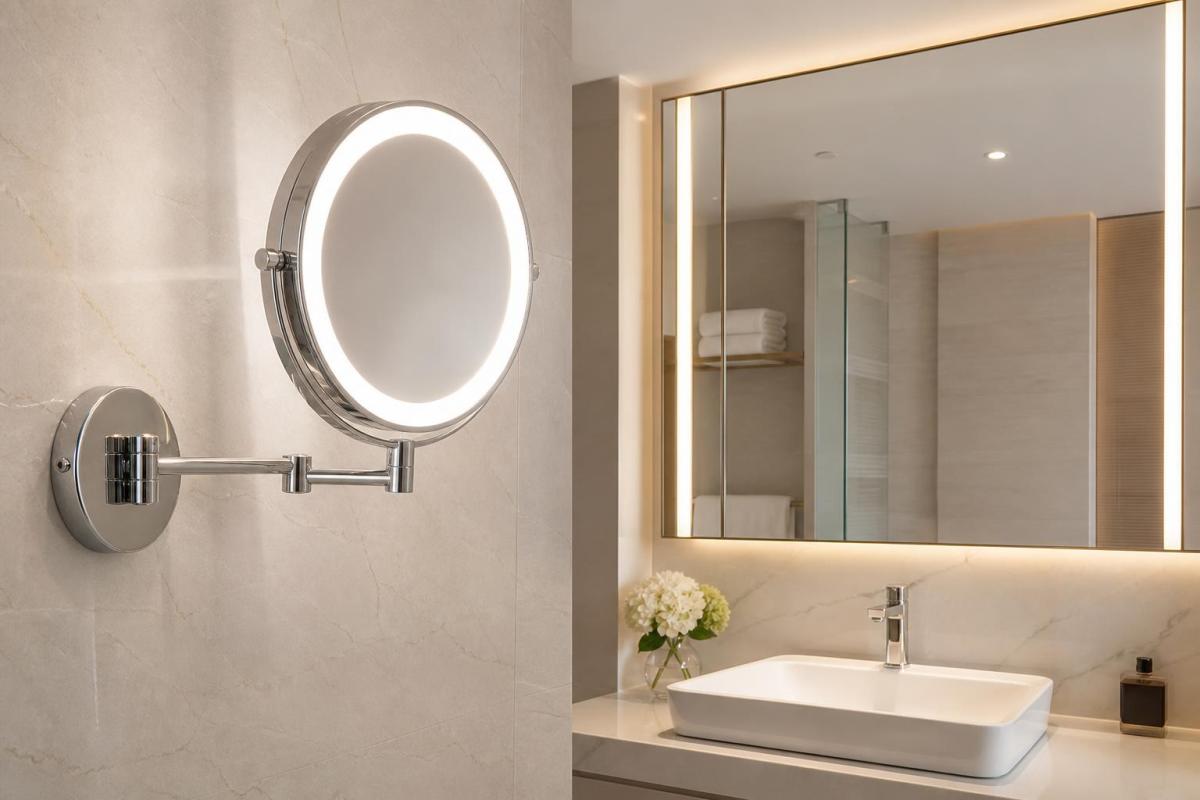
The category usually refers to magnifying mirrors with integrated lighting, designed for close facial tasks. Most models used in hospitality settings are wall-mounted, though countertop formats also appear in premium suites.
A high-performing unit should deliver three things at the same time. It needs comfortable viewing size, light that reveals skin tones accurately, and a mounting system that survives repeated use.
The mistake in many sourcing discussions is treating all illuminated makeup mirrors hotel catalogs list as interchangeable. In practice, a mirror suited for a small city hotel may fail in a resort, spa suite, or accessible guestroom.
Operational context changes the correct specification. Humidity levels, cleaning chemicals, wall construction, user frequency, and vanity layout all affect what “best” actually means.
Size decisions should start with use distance and vanity layout
Mirror size is often discussed in diameter only, but that is incomplete. A better starting point is the viewing distance created by the arm length, sink depth, and counter position.
For many guestrooms, mirrors between 7 and 9 inches provide a balanced field of view. They are large enough for makeup and shaving, but not so large that they overpower compact bathroom walls.
Larger mirrors can improve usability in upscale properties, especially where guests expect comfort rather than minimal compliance. However, larger diameter also increases perceived bulk and may require stronger arm construction.
Magnification should be evaluated with equal care. Five-times magnification is usually practical for broad hotel use. Seven-times or higher can be useful, but some guests find it too strong for general grooming.
Quick size and usability reference
If the layout includes double vanities or narrow side walls, exact swing radius becomes more important than nominal size. A mirror that looks right on paper can still interfere with faucets, sconces, or towel bars.
Lighting performance is where many buying decisions succeed or fail
Guests notice lighting quality immediately, even when they cannot describe it technically. Poor lighting creates shadows, distorts skin tone, and makes precision grooming harder. In reviews, that becomes “the bathroom felt inconvenient.”
For illuminated makeup mirrors hotel teams compare, color temperature and color rendering should be reviewed together. Around 3000K to 4000K often works well, depending on the room’s main lighting scheme.
Color rendering index also matters. A CRI of 90 or above is generally a stronger target when accurate makeup application is important. Lower CRI may flatten tones or shift color perception.
Brightness should be sufficient for task use without creating glare. Diffused LED lighting usually performs better than harsh point sources, especially when the mirror is used at close range.
Lighting checkpoints worth requesting from suppliers
- Rated color temperature and whether it is fixed or adjustable
- CRI value under normal operating conditions
- LED lifetime rating and driver stability
- Glare control, diffuser design, and edge brightness uniformity
- Power consumption and standby behavior
- Ingress protection if humid environments are expected
This is where the TSV approach is useful. Instead of accepting phrases like “soft luxury lighting,” request measurable values. Light output, CRI, service hours, and driver quality reveal far more than styling language.
Mounting options should match the room build, not just the design brief
Mounting method affects both the guest experience and the total installation burden. Wall-mounted articulated arms remain the most common choice because they save counter space and support adjustable positioning.
Hardwired models often deliver a cleaner appearance and reduce visible cords. They are usually preferred in new construction or full renovation projects where electrical rough-in can be planned early.
Plug-in or battery-supported options can simplify retrofit work, though they may introduce charging logistics, visible wiring, or lower consistency across rooms. That tradeoff should be evaluated before rollout.
Mounting strength deserves special attention. Repeated extension and folding create cyclic loads at anchor points. In weaker substrates, failure may come from the wall interface rather than from the mirror itself.
Common mounting paths in hotel environments
In actual use, the best illuminated makeup mirrors hotel installations often come from matching mount type to maintenance realities. Easy access for service can be as valuable as a polished visual finish.
Material durability and maintenance shape total cost over time
Initial purchase price is only one part of the equation. Hospitality bathrooms expose mirrors to steam, cleaning agents, frequent handling, and occasional impact. Surface finish and joint quality therefore matter a great deal.
Corrosion-resistant finishes such as quality chrome, brushed nickel, or treated matte black are often selected for appearance, yet durability standards should sit behind that choice. Finish failure quickly undermines room perception.
Pay attention to hinge play, spring tension retention, LED driver replacement, and whether the reflective surface is sealed against edge degradation. These are practical indicators of service life.
If replacement components are not available, even a minor failure can force full unit replacement. Across large room counts, that becomes a predictable but avoidable expense.
How to compare suppliers without getting lost in vague claims
The market for illuminated makeup mirrors hotel sourcing often includes broad claims about luxury feel, premium build, or superior illumination. These descriptions are not useless, but they should never stand alone.
A stronger comparison sheet includes electrical certification, lumen consistency, material thickness, mounting plate dimensions, arm cycle expectations, finish testing, and warranty scope. This creates a fairer evaluation baseline.
Request installation drawings early. A mirror that meets visual expectations may still create conflicts with tile joints, blocking, outlet placement, or mirror-to-sconce spacing.
Sample-room testing remains one of the most reliable filters. In a live bathroom setting, light tone, reach, glare, and folded profile become easier to judge than in a catalog or showroom.
A practical evaluation checklist
- Confirm mirror size against actual vanity and wall dimensions
- Match magnification to likely guest comfort and use frequency
- Verify CRI, color temperature, and glare control
- Review mounting substrate, blocking, and electrical path
- Check finish resistance in humid and chemical-cleaning conditions
- Ask about parts availability and replacement procedure
Turning selection criteria into a smarter purchasing standard
The most effective illuminated makeup mirrors hotel programs are built around repeatable standards, not one-time visual preference. Once the right size, light performance, and mounting approach are defined, specification becomes easier to scale.
That is also where a data-led sourcing philosophy becomes practical. A mirror may be a small fixture, but disciplined comparison still reduces replacement cycles, installation errors, and guest friction.
Before the next sourcing round, it helps to document room types, wall conditions, target finish families, and preferred lighting parameters. From there, shortlist options against measurable requirements rather than catalog language.
When the specification sheet is clear, supplier conversations become shorter, comparisons become fairer, and the final choice is easier to defend across design, operations, and ownership priorities.
Search News
Hot Articles
- Carbon Fiber StructuresHow to Specify Aerospace Carbon Fiber Assemblies for Lightweight, Load-Bearing PartsJul 11, 2026
- Machine VisionXiaomi, Alibaba DAMO Academy Drive Open-Source Robotics Model Ecosystem, Lowering Algorithm Development Barriers for Overseas SMEs Adopting Chinese Robotics SolutionsMar 30, 2026
- Cobots & ArmsShanxi 'AI+' Conference Showcases Embodied Intelligence with Multinational Buyer Engagement: Key Industry ImplicationsMar 30, 2026
Popular Tags
Recommended News
 Jul 11, 2026How to Specify Aerospace Carbon Fiber Assemblies for Lightweight, Load-Bearing PartsAerospace carbon fiber assemblies: learn how to specify laminate design, load data, joining methods, and inspection controls for lighter, reliable load-bearing aerospace parts.Elena Rostova (UAV Systems Researcher)
 Mar 30, 2026Xiaomi, Alibaba DAMO Academy Drive Open-Source Robotics Model Ecosystem, Lowering Algorithm Development Barriers for Overseas SMEs Adopting Chinese Robotics SolutionsXiaomi & Alibaba DAMO Academy's open-source robotics models lower algorithm barriers for global SMEs. Boost efficiency in manufacturing, logistics & smart retail with ROS 2 compatible solutions.TSV Data Lab
 Mar 30, 2026Shanxi 'AI+' Conference Showcases Embodied Intelligence with Multinational Buyer Engagement: Key Industry ImplicationsShanxi 'AI+' Conference highlights embodied intelligence with Tesla, Ubtech & Jiantao showcasing multimodal robotics. 40+ global buyers validated tech on-site, creating new B2B channels for industrial automation & AI solutions.Chen Wei (Automation Lead Engineer)
 Mar 30, 2026Zhongguancun Unveils 6G Integrated Sensing-Computing-Intelligence Platform to Empower Embodied Robots for Global Industrial ApplicationsZhongguancun's new 6G platform revolutionizes industrial robotics with <10ms latency, empowering global automotive, logistics & port automation. Discover how this tech boosts China's smart manufacturing exports.TSV Data Lab
 Mar 30, 2026Mech-Mind Tianjin Embodied Intelligence R&D and Production Base Goes Live, Cutting Delivery Time by 20%–30% for Global Customized AMR+Vision SolutionsMech-Mind's Tianjin AMR+Vision production base cuts delivery time by 20%-30% for欧美 & Latin American markets. Discover how this PLd-certified facility accelerates customized robotics solutions for smart manufacturing and logistics.Chen Wei (Automation Lead Engineer)
 Mar 30, 2026Boao Forum Reveals 'Co-evolution of Big and Small Brains' Trend in Humanoid Robots, China's Embodied Intelligence Accelerates Adaptation to Overseas Manufacturing Service ScenariosDiscover how China's humanoid robots, featuring 'Co-evolution of Big and Small Brains,' are revolutionizing global manufacturing. Learn about Embodied Tian Gong 3.0's ISO compliance and overseas deployment at Boao Forum 2026.Chen Wei (Automation Lead Engineer)
 Mar 30, 2026China Railway Industrial Secures Patent for Embodied Robotics in Material Handling, Boosting High-Precision Delivery Capabilities for Overseas Infrastructure and Manufacturing ProjectsChina Railway Industrial's new patent for embodied robotics in material handling boosts high-precision delivery for global infrastructure & manufacturing. Discover how this innovation enhances logistics accuracy in automotive, rail transit & EPC projects.Chen Wei (Automation Lead Engineer)
 Sep 22, 2026Drone Engine-T550CC Applications: Build the UAV Power System Around the MissionAn application guide for Drone Engine-T550CC integration, covering payload planning, airframe matching, cooling, fuel, vibration, test procedures, documentation, and service preparation.Elena Rostova (UAV Systems Researcher)
 Sep 22, 2026How to Evaluate Industrial Edge Computing Vendors for Factory DeploymentIndustrial edge computing vendor evaluation guide for factories: compare latency, protocol fit, reliability, security, and lifecycle support before deployment.TSV Data Lab
 Sep 21, 2026Drone Payload Integration: Matching Power, Data, and Center of Gravity for Reliable FlightsDrone payload integration made practical: balance power, data, center of gravity, and endurance to build safer, more reliable mission-ready flights.Elena Rostova (UAV Systems Researcher)
 Sep 20, 2026Autonomous Navigation Pricing: Cost Drivers and Budget Benchmarks for AMR ProjectsAutonomous navigation price explained: compare AMR cost drivers, software, sensors, integration, safety, and lifecycle budgets to build a scalable project plan.Chen Wei (Automation Lead Engineer)
 Sep 19, 2026How to Scope Automation Integration Services for Multi-System Factory ProjectsAutomation integration services: learn how to scope multi-system factory projects with clear workflows, interface contracts, safety boundaries, and acceptance criteria.Victor Lin (Chief Software Architect)
 Sep 18, 2026Selecting UAV Aerospace Structural Parts for Strength, Weight, and Fatigue LifeUAV aerospace structural parts guide: compare strength, weight, stiffness, fatigue life, joints, and traceability to select reliable flight-ready components.Elena Rostova (UAV Systems Researcher)
 Sep 17, 2026Selecting Commercial Drone Payloads for European Inspection ProjectsCommercial drone payloads Europe: learn how to select RGB, thermal and LiDAR systems for compliant, reliable inspection data and better project outcomes.Elena Rostova (UAV Systems Researcher)
 Sep 16, 2026Machining Tolerance Validation: How to Verify Critical Dimensions Before Production ReleaseMachining tolerance analysis validation: verify critical dimensions, measurement systems, process capability, and tolerance stacks before production release.Dr. Marcus Vance
 Sep 15, 2026AGV Tape Guidance vs Laser Navigation: Which Fits Your Warehouse Layout?AGV tape guidance comparison: discover how tape and laser navigation fit changing warehouse layouts, docking needs, floor conditions, maintenance, and route flexibility.Chen Wei (Automation Lead Engineer)
 Sep 14, 2026How Point Cloud Analytics Improves Asset Inspection Workflows Across GCC ProjectsPoint cloud analytics GCC helps project leaders improve asset inspections with accurate change detection, safer workflows, and faster maintenance decisions.TSV Data Lab
 Sep 13, 2026How Aerospace Manufacturers Can Build a Digital Thread From Design to Certified ProductionDigital manufacturing for aerospace: learn how to build a traceable digital thread from design through certified production, supplier control, and audit-ready compliance.Victor Lin (Chief Software Architect)
 Sep 12, 2026How to Select a Thermal Sensor for Mapping Drones in Surveying ProjectsMapping drone thermal sensor selection made simple: compare GSD, radiometric data, NETD, calibration, and workflow fit for accurate, survey-ready thermal maps.Elena Rostova (UAV Systems Researcher)
 Sep 11, 2026Integrating Photogrammetry Workflows into Digital Twin Projects Without Data BottlenecksPhotogrammetry workflow integration for digital twins: learn how to streamline capture, validation, versioning, and delivery to prevent data bottlenecks.Victor Lin (Chief Software Architect)
 Sep 10, 2026Hard-Tech Supply Chain Procurement: Qualifying Suppliers to Cut Lead-Time RiskHard-tech supply chain procurement guide: qualify suppliers with proven process, traceability, capacity, and change control to reduce lead-time risk.Chen Wei (Automation Lead Engineer)
 Sep 09, 2026Industrial Application Notes: Cost Factors That Shape Automation Project BudgetsIndustrial application notes cost factors explained: uncover the engineering, safety, integration, and commissioning variables that shape accurate automation budgets.Victor Lin (Chief Software Architect)
 Sep 08, 2026Supplier Discovery for Sourcing: How Buyers Can Verify Capability and Supply RiskSupplier discovery for sourcing: learn how to verify supplier capability, traceability, quote assumptions, and supply risk before placing production orders.TSV Data Lab
 Sep 07, 2026What Determines Process Control Systems Pricing? A Buyer’s Cost GuideProcess control systems pricing explained: compare hardware, engineering, integration, cybersecurity, validation, and lifecycle costs to choose the right-value solution.Victor Lin (Chief Software Architect)