Palletizing Robot Suppliers for Mixed SKU Lines: What Works Best
Publication Date
author
For operators running mixed SKU lines, choosing the right palletizing robot suppliers is not about flashy claims—it is about uptime, gripper flexibility, changeover speed, and stable performance under real production pressure. This guide examines what actually works best, helping frontline users compare suppliers through practical engineering criteria instead of marketing noise.
Why mixed SKU lines change how palletizing robot suppliers should be evaluated
A supplier that performs well in a single-size, high-volume palletizing cell may fail in a mixed SKU environment. Operators on mixed lines deal with cartons, bags, shrink-wrapped packs, trays, and unstable loads that change by shift or even by hour. In that setting, the best palletizing robot suppliers are the ones that reduce manual intervention, recover quickly from variation, and keep recipes simple enough for real production staff to manage.
The core issue is not just robot speed. A line can lose more time in pattern changes, failed picks, barcode mismatch, slip-sheet handling, or poor end-of-arm tooling than it loses in raw cycle rate. That is why users and operators should judge palletizing robot suppliers based on total line behavior: how the system sees products, grips them, builds stable pallets, and supports recovery when inputs are imperfect.
In practical terms, mixed SKU palletizing demands a supplier that can integrate mechanics, controls, vision, safety, and service. If one part is weak, the whole cell becomes operator-dependent. Good suppliers design for the real world, where products arrive skewed, labels vary, infeed timing is not perfect, and pallet quality is inconsistent.
What operators usually care about first
Frontline users often rank priorities differently from procurement teams. They care less about brochure payload claims and more about whether the system keeps running after eight hours of line variation. Ease of teaching, alarm clarity, and access to spare parts often matter more than headline robot brand.
- Fast changeovers between different carton sizes and pallet patterns
- Reliable gripping across different package surfaces and weights
- Simple HMI recipe selection and fault recovery
- Stable pallet quality without frequent manual restacking
- Responsive service support when the cell stops
A fast scenario comparison before you shortlist suppliers
Three common mixed SKU applications and what each one really needs
Not all mixed lines behave the same way. When comparing palletizing robot suppliers, start by defining your application family. The supplier that fits packaged beverages may not be ideal for e-commerce parcels or heavy industrial sacks. This is where many projects go wrong: the system is technically capable, but poorly matched to the operating scenario.
Below are three common scenarios that help users narrow the field. Each one changes the balance between speed, flexibility, and mechanical robustness. Operators should ask suppliers for proof tied to the same type of line conditions, not generic claims.
The goal is to identify what works best in context. A good supplier should be able to explain where its design performs strongly, where it needs constraints, and how much operator involvement remains after installation.
Scenario 1: Fast-moving case lines with frequent recipe changes
This is common in food, beverage, household goods, and consumer packaging. Cartons may be fairly regular, but line speed is high and pallet patterns change often. Operators need quick recipe calls, consistent case orientation, and minimal interruption between production runs.
For this scenario, the best palletizing robot suppliers usually offer standardized cells with proven software libraries. Pattern generation should be quick, slip-sheet logic should be stable, and HMI workflows should let operators switch products without engineering support. If every change requires a controls specialist, the system is too fragile for the floor.
What to check
- Recipe change time under actual production conditions
- Ability to handle skewed or slightly damaged cartons
- Stack stability at top pallet layers
- Clear fault messages and restart logic after jams
Scenario 2: E-commerce, retail fulfillment, and 3PL mixed parcel palletizing
This is one of the hardest environments for palletizing robot suppliers. Parcel dimensions change constantly, weights can be inconsistent, and package rigidity is often poor. A robot that depends on neat infeed spacing or uniform box geometry will struggle. Here, software and perception matter as much as robot arm selection.
What works best is usually a cell with strong vision integration, adaptive gripping, and dynamic decision-making for pallet build quality. Suppliers should show how their system handles unknown dimensions, crushed corners, label glare, and partial load logic. Operators need confidence that exceptions do not become a full-time manual task.
This scenario also puts pressure on upstream and downstream integration. If WMS, barcode systems, or order logic are not synchronized, even a good robot cell can misbuild pallets. The strongest palletizing robot suppliers understand this and offer better interface discipline, not just mechanical hardware.
Scenario 3: Heavy bags, pails, drums, or industrial pack formats
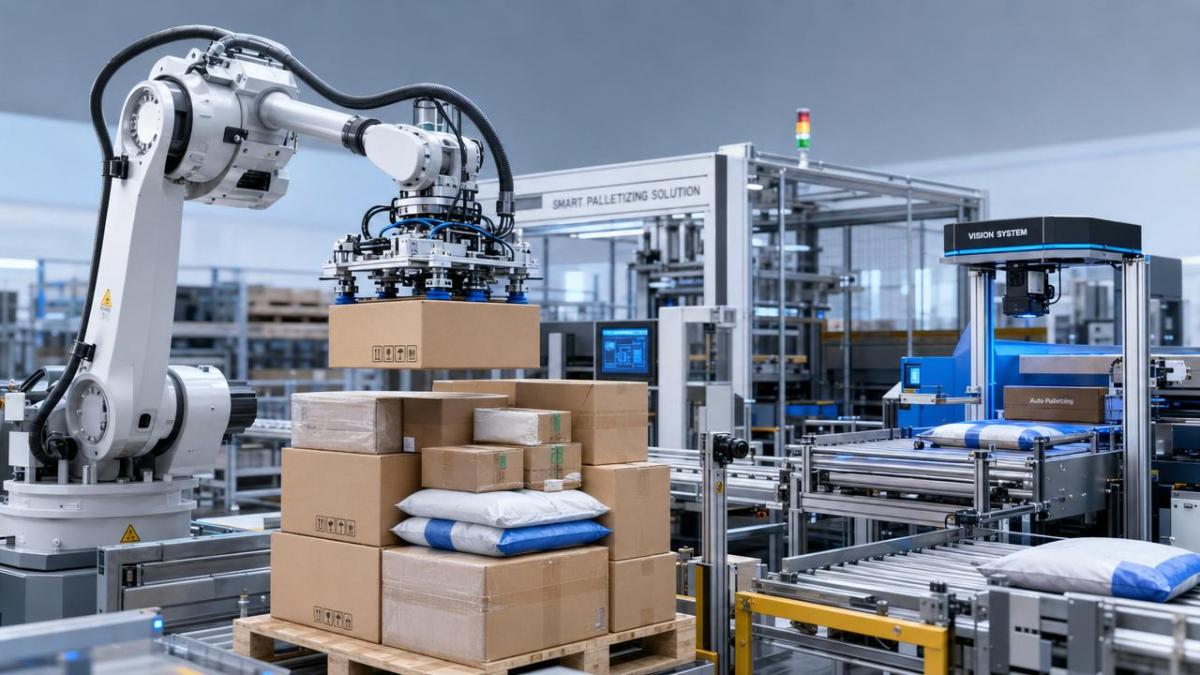
In industrial sectors, mixed SKU palletizing often includes products with difficult surfaces, shifting center of gravity, dust, or high weight. A bag may deform; a pail may need top-clamp control; a drum may require special positioning. In these cases, speed is important, but secure handling and safety margins come first.
The right palletizing robot suppliers for this application usually emphasize rugged end-of-arm tooling, safety interlocks, and conservative but repeatable cycle design. Suppliers should be open about payload derating, environmental tolerance, and maintenance intervals. Operators should be cautious of systems that look flexible in demos but need ideal product presentation to perform.
This is also where service quality becomes decisive. Heavy or dusty environments expose weak cable routing, poor sensor protection, and underdesigned wear points quickly. A supplier with strong field support and parts planning often outperforms a more glamorous but less practical option.
How to compare palletizing robot suppliers using practical engineering criteria
Once the application type is clear, comparison becomes more objective. Instead of starting with brand reputation alone, users should evaluate the complete palletizing cell around measurable operating needs. This approach aligns with TSV’s data-first mindset: parameters, recoverability, and line behavior tell more truth than generic claims.
A supplier should be judged on whether the system maintains performance when real inputs vary. That includes package quality, pallet variation, ambient dust, line speed fluctuations, and operator skill differences. The strongest palletizing robot suppliers can show acceptance logic for those variables before commissioning starts.
Operators should also focus on everyday usability. A technically advanced cell is not truly effective if routine adjustments require constant vendor intervention. Ease of operation is a performance metric, not a luxury feature.
Five criteria that matter most on mixed lines
- End-of-arm tooling flexibility: Can the gripper handle different materials, box stiffness, and product dimensions without constant tuning?
- Recipe management: How fast can operators add, modify, and recall pallet patterns safely?
- Fault recovery: Does the system restart cleanly after missed picks, pallet replacement, or infeed disruption?
- Integration quality: How well does the cell connect with conveyors, scanners, label data, and plant controls?
- Serviceability: Are wear parts accessible, spare components available, and support response realistic for your shift pattern?
A supplier comparison table operators can actually use
Common mistakes when selecting palletizing robot suppliers for mixed SKU operations
A frequent mistake is buying for theoretical maximum throughput rather than average shift reality. On mixed lines, uptime and recovery often drive more value than peak cycles per minute. A slower but more tolerant system can outperform a faster cell that stops whenever package quality changes.
Another mistake is testing with too few SKUs. If a supplier demo covers only your easiest cartons, the result is misleading. Users should include edge cases: the soft box, the glossy label, the tallest case, the smallest footprint, the bag with unstable fill, and the pallet that arrives slightly out of tolerance. That is how palletizing robot suppliers should be stress-tested.
A third error is underestimating operator interface design. Mixed SKU palletizing depends on clear recipes, safe overrides, and simple recovery. If the HMI is confusing, downtime grows. In practice, interface quality directly affects labor dependence and output stability.
Questions users should ask before approval
- What SKU range has been validated on the proposed gripper?
- What is the actual recipe creation process for new products?
- How does the cell recover after a dropped unit or bad pallet entry?
- Which wear parts are expected to need routine replacement?
- What local or remote support is guaranteed during production hours?
Where supplier claims should be verified with data
Ask for cycle performance by SKU type, not just one average number. Ask for pallet quality consistency after long runs, not only the first ten minutes. Ask for failure modes, alarm frequency, and recovery steps. Reliable palletizing robot suppliers should be willing to discuss these details because they know mixed SKU success depends on them.
What works best in the end: matching supplier strength to your operating reality
The best palletizing robot suppliers for mixed SKU lines are rarely the ones with the broadest claims. They are the suppliers whose design strengths match your exact mix of package variability, pallet rules, labor model, and recovery needs. For high-speed case lines, standardized recipe logic and reliable pattern control often work best. For e-commerce and 3PL applications, vision-led flexibility and exception handling matter more. For heavy industrial products, rugged handling and field service are often decisive.
From an operator perspective, the winning solution is the one that keeps manual intervention low and system behavior predictable across a full shift. That means you should evaluate palletizing robot suppliers in live scenario terms: what arrives at the infeed, what can go wrong, who resets the cell, and how quickly normal flow returns. If a supplier cannot answer that clearly, the fit is probably weak.
Before making a final decision, map your top twenty SKUs, your worst-case package conditions, your expected pallet formats, and your required response time for faults. Then compare palletizing robot suppliers against those exact conditions. In mixed SKU operations, what works best is not the most dramatic promise. It is the most stable, testable, and supportable system for your real production floor.
Search News
Hot Articles
- Carbon Fiber StructuresHow to Specify Aerospace Carbon Fiber Assemblies for Lightweight, Load-Bearing PartsJul 11, 2026
- Machine VisionXiaomi, Alibaba DAMO Academy Drive Open-Source Robotics Model Ecosystem, Lowering Algorithm Development Barriers for Overseas SMEs Adopting Chinese Robotics SolutionsMar 30, 2026
- Cobots & ArmsShanxi 'AI+' Conference Showcases Embodied Intelligence with Multinational Buyer Engagement: Key Industry ImplicationsMar 30, 2026
Popular Tags
Recommended News
 Jul 11, 2026How to Specify Aerospace Carbon Fiber Assemblies for Lightweight, Load-Bearing PartsAerospace carbon fiber assemblies: learn how to specify laminate design, load data, joining methods, and inspection controls for lighter, reliable load-bearing aerospace parts.Elena Rostova (UAV Systems Researcher)
 Mar 30, 2026Xiaomi, Alibaba DAMO Academy Drive Open-Source Robotics Model Ecosystem, Lowering Algorithm Development Barriers for Overseas SMEs Adopting Chinese Robotics SolutionsXiaomi & Alibaba DAMO Academy's open-source robotics models lower algorithm barriers for global SMEs. Boost efficiency in manufacturing, logistics & smart retail with ROS 2 compatible solutions.TSV Data Lab
 Mar 30, 2026Shanxi 'AI+' Conference Showcases Embodied Intelligence with Multinational Buyer Engagement: Key Industry ImplicationsShanxi 'AI+' Conference highlights embodied intelligence with Tesla, Ubtech & Jiantao showcasing multimodal robotics. 40+ global buyers validated tech on-site, creating new B2B channels for industrial automation & AI solutions.Chen Wei (Automation Lead Engineer)
 Mar 30, 2026Zhongguancun Unveils 6G Integrated Sensing-Computing-Intelligence Platform to Empower Embodied Robots for Global Industrial ApplicationsZhongguancun's new 6G platform revolutionizes industrial robotics with <10ms latency, empowering global automotive, logistics & port automation. Discover how this tech boosts China's smart manufacturing exports.TSV Data Lab
 Mar 30, 2026Mech-Mind Tianjin Embodied Intelligence R&D and Production Base Goes Live, Cutting Delivery Time by 20%–30% for Global Customized AMR+Vision SolutionsMech-Mind's Tianjin AMR+Vision production base cuts delivery time by 20%-30% for欧美 & Latin American markets. Discover how this PLd-certified facility accelerates customized robotics solutions for smart manufacturing and logistics.Chen Wei (Automation Lead Engineer)
 Mar 30, 2026Boao Forum Reveals 'Co-evolution of Big and Small Brains' Trend in Humanoid Robots, China's Embodied Intelligence Accelerates Adaptation to Overseas Manufacturing Service ScenariosDiscover how China's humanoid robots, featuring 'Co-evolution of Big and Small Brains,' are revolutionizing global manufacturing. Learn about Embodied Tian Gong 3.0's ISO compliance and overseas deployment at Boao Forum 2026.Chen Wei (Automation Lead Engineer)
 Mar 30, 2026China Railway Industrial Secures Patent for Embodied Robotics in Material Handling, Boosting High-Precision Delivery Capabilities for Overseas Infrastructure and Manufacturing ProjectsChina Railway Industrial's new patent for embodied robotics in material handling boosts high-precision delivery for global infrastructure & manufacturing. Discover how this innovation enhances logistics accuracy in automotive, rail transit & EPC projects.Chen Wei (Automation Lead Engineer)
 Oct 28, 2026IDC: Global Quadruped Robot Shipments Rise 92.5% in H1 2026 as Volume and Value DivergeGlobal quadruped robot shipments rose 92.5% in H1 2026, according to IDC. Explore what diverging volume and value trends mean for industrial buyers and manufacturers.Chen Wei (Automation Lead Engineer)
 Oct 28, 2026Interpreting Industrial IoT Latency Data for Monitoring and Real-Time ControlInterpret industrial category latency data to assess jitter, deadline misses, and real-time readiness. Learn how to benchmark IIoT systems and choose monitoring and control solutions.TSV Data Lab
 Oct 27, 2026GXO and Agility Robotics Expand Partnership to Accelerate US Humanoid Robot DeploymentGXO and Agility Robotics plan to expand US humanoid robot deployment with Digit 4 in early 2027. Explore warehouse automation plans, service terms and future Digit 5 upgrades.Chen Wei (Automation Lead Engineer)
 Oct 27, 2026Robotic Automation Costs: Budgeting for Equipment, Integration, and MaintenancePlan your robotics automation cost with confidence. Explore equipment, integration, and maintenance expenses, compare quotes, and build a realistic budget for better ROI.Chen Wei (Automation Lead Engineer)
 Oct 26, 2026AMAXiMAL Releases Open-Source TopMod 3D v3 With Claude AIExplore AMAXiMAL’s free, open-source TopMod 3D v3 with Claude AI assistance, topology-based modeling and plywood fabrication tools that connect complex designs to physical builds.Dr. Marcus Vance
 Oct 26, 2026Choosing a SCADA System Integrator Company: PLC Compatibility and Long-Term SupportChoose a scada system integrator company with proven PLC compatibility and reliable long-term support. Discover what to test, compare, and require before investing.Victor Lin (Chief Software Architect)
 Oct 25, 2026Hesai Leads Global ADAS Main Lidar Shipments in Yole’s 2026 ReportHesai led global ADAS main lidar shipments with a 43% share in 2025, according to Yole’s 2026 report. Explore what this ranking reveals about its automotive market position.TSV Data Lab
 Oct 25, 2026Choosing an Aerospace Materials Manufacturer: Quality and Traceability ChecksChoosing an aerospace materials manufacturer? Learn how to verify certifications, test reports, and lot traceability to qualify suppliers confidently and reduce costly sourcing risks.Dr. Marcus Vance
 Oct 24, 2026Guotai Haitong: Global Entry-Level 3D Printer Shipments Rose 39% in Q1 2026Entry-level 3D printer shipments rose 39% in Q1 2026, Guotai Haitong reports. Explore how AI, multicolor printing and print farms are shaping market growth.Dr. Marcus Vance
 Oct 24, 2026Choosing an Industrial Vision Inspection Supplier: Acceptance Tests That MatterChoose an industrial vision inspection supplier with confidence. Discover acceptance tests for defect detection, false rejects, production speed, and reliable part rejection before you buy.TSV Data Lab
 Oct 23, 2026US Navy Raises Gecko Robotics Contract Ceiling to $300M for Robotic Fleet MaintenanceUS Navy raises Gecko Robotics’ contract ceiling to $300M for Pacific Fleet robotic inspections. Explore potential opportunities for maintenance suppliers and key procurement considerations.Chen Wei (Automation Lead Engineer)
 Oct 23, 2026Choosing Industrial Sensing Systems for Global Plants: Protocol CompatibilityCompare industrial sensing systems international buyers can trust. Explore protocol compatibility, reduce integration risks, and select proven configurations for reliable global plant deployments.TSV Data Lab
 Oct 22, 2026KUKA Showcases Physical AI and iiQKA.AI Vision at NVIDIA GTC BerlinExplore KUKA’s Physical AI showcase at NVIDIA GTC Berlin and discover how iiQKA.AI Vision aims to simplify robotic vision integration and improve 2D and 3D scene recognition.TSV Data Lab
 Oct 22, 2026Robotic Machining of Advanced Composites: What Tolerances Are Achievable?Explore advanced materials machining robotics: discover what drives achievable composite tolerances and how to validate accuracy before investing in your next machining system.Dr. Marcus Vance
 Oct 21, 2026China’s Industrial Robot Exports Near RMB 10 Billion in First Nine Months of 2026China’s industrial robot exports neared RMB 10 billion in January–September 2026, with value rising faster than volume. Explore the data and what it could mean for suppliers.Chen Wei (Automation Lead Engineer)
 Oct 21, 2026Low-Latency Industrial Data Processing: Pricing and Key Cost DriversExplore industrial data latency price drivers, from edge hardware to integration and support. Learn how to compare quotes, verify performance, and avoid unnecessary costs.TSV Data Lab
 Oct 20, 2026KUKA Launches iiQKA.AI Vision to Simplify Industrial Image ProcessingKUKA iiQKA.AI Vision simplifies industrial image processing with controller-based 2D and 3D vision. Explore drag-and-drop setup for vision-guided automation.TSV Data Lab