6 Axis Robot Arm Wholesale for Integrators: Which Specs Matter Most?
Publication Date
author
In 6 axis robot arm wholesale, integrators and channel partners cannot rely on vague claims or polished brochures. What truly matters are the hard specifications that determine deployment success: repeatability, payload, reach, cycle time, controller compatibility, and long-term reliability. This guide cuts through marketing noise to help distributors, agents, and industrial resellers identify the metrics that directly affect sourcing decisions, project performance, and customer trust.
Why a checklist approach works better in 6 axis robot arm wholesale
For integrators, the real challenge in 6 axis robot arm wholesale is not finding suppliers with attractive brochures. It is identifying which robot specifications will hold up in actual welding, pick-and-place, palletizing, machine tending, assembly, or inspection projects. A shortlist built on the wrong metrics often leads to integration delays, tooling redesign, performance disputes, or costly field failures.
A checklist-based review is effective because it forces a structured comparison. Instead of asking which brand sounds stronger, buyers can ask which arm delivers stable repeatability under rated payload, which controller supports target fieldbus protocols, and which model has sufficient wrist inertia tolerance for the end effector and workpiece combination. This is the level of detail channel partners need when serving demanding industrial customers.
This method also aligns with the data-first mindset promoted by serious engineering procurement. TechStat Vanguard consistently emphasizes that sourcing decisions improve when teams compare measurable thresholds rather than slogans. For distributors and agents, that means building product portfolios around verifiable technical fit, support readiness, and lifecycle economics.
- Use specification checklists to reduce mismatches between quoted capability and real application demand.
- Compare robots by deployment risk, not just purchase price.
- Standardize your sourcing review so sales, engineering, and after-sales teams use the same decision criteria.
The first filter before you request a quotation
Before requesting pricing in 6 axis robot arm wholesale, verify whether the supplier can provide complete data sheets, controller documentation, maintenance intervals, communication options, and payload curves. If these basics are unclear, deeper technical promises are difficult to trust.
A serious wholesale evaluation should begin with application fit, then performance limits, then serviceability. This order helps channel partners avoid the common mistake of choosing low-cost hardware first and discovering compatibility issues later.
Core specification checklist: what matters most to integrators
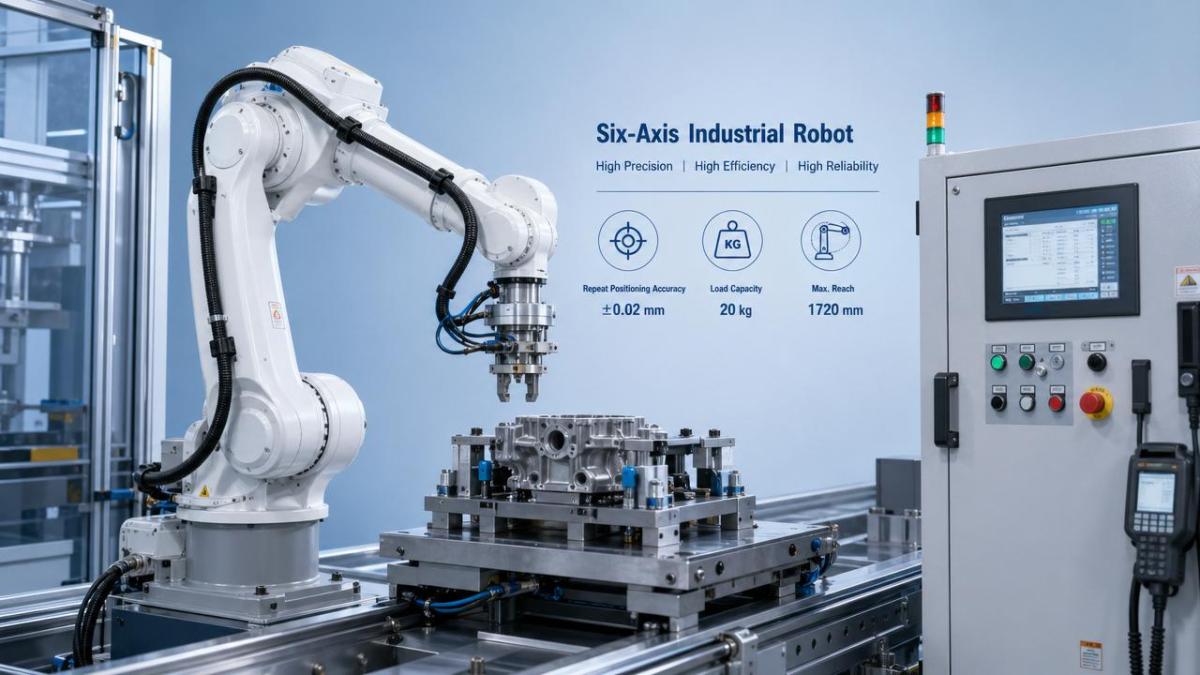
When reviewing 6 axis robot arm wholesale opportunities, some specifications matter far more than others. The following checklist focuses on the parameters that directly affect installation feasibility, takt time, process quality, and long-term support. These are the metrics that should appear in your internal comparison sheet.
The most important rule is simple: never read a specification in isolation. Payload without reach is incomplete. Repeatability without cycle conditions can mislead. Speed without acceleration profile says little about actual output. Integrators should evaluate interdependent performance, not isolated headline numbers.
Below is a practical priority table for channel decision-makers handling 6 axis robot arm wholesale programs.
Repeatability: the specification most often oversimplified
In 6 axis robot arm wholesale, repeatability is often the first metric mentioned and the least properly examined. Many channel buyers assume a lower number always guarantees better results. In reality, repeatability depends on payload condition, motion path, temperature, fixture rigidity, and tool mass distribution.
Ask whether the published repeatability was measured according to recognized test methods and whether it reflects point-to-point accuracy only. Some applications such as dispensing, arc welding, and polishing depend heavily on path accuracy, which can differ significantly from repeatability. If path control matters, request demonstration data or sample process validation.
Repeatability check items
- Published repeatability value and test condition
- Performance under near-maximum payload
- Tool center point calibration method
- Path stability for continuous-process applications
Payload, wrist torque, and inertia: the hidden trio
A common mistake in 6 axis robot arm wholesale is to compare payload ratings only. Integrators know that a robot carrying a gripper, vision bracket, hose package, and part may exceed wrist moment or inertia limits before reaching nominal payload. This is especially important in fast transfer applications where acceleration loads are high.
Distributors should ask for payload charts, flange load data, allowable center-of-gravity distance, and axis torque limitations. A robot that appears suitable on paper can become unreliable or slow once tool inertia forces speed reduction. That directly affects cycle time and customer satisfaction.
Application-based checks: specs change by scenario
Not every 6 axis robot arm wholesale project should be judged with the same weighting. A machine tending cell values reach, ingress protection, and controller handshake stability. A polishing project may care more about path smoothness, force control options, and vibration behavior. A palletizing alternative might prioritize load handling and throughput over ultra-fine repeatability.
For channel partners, application mapping is the bridge between generic catalog data and a saleable solution. It helps you recommend the right model family, estimate integration complexity, and avoid warranty arguments caused by incorrect use cases.
Use the following scenario checklist before confirming any wholesale selection.
- Define the process: welding, assembly, machine tending, gluing, packaging, inspection, or handling.
- Calculate total load including gripper, fixture interface, cables, and part variation.
- Map the workspace envelope and identify singularity or collision risks.
- Confirm environmental conditions such as dust, coolant mist, ambient temperature, and duty cycle.
- Check control architecture, safety requirements, and customer-preferred PLC ecosystem.
What distributors should prioritize by use case
For welding and dispensing, emphasize path consistency, software package maturity, and cable routing durability. For high-speed material handling, validate acceleration capability, short-stroke optimization, and end-of-arm load limits. For machine tending, focus on reach into enclosures, base mounting options, and door or chuck communication reliability.
If your portfolio serves mixed sectors, create a use-case matrix rather than one universal recommendation. This improves quote accuracy and helps your sales team qualify opportunities faster.
The specs many buyers overlook in 6 axis robot arm wholesale
Some of the most expensive errors in 6 axis robot arm wholesale come from factors that are not highlighted on the first page of a brochure. These secondary specifications often determine how easy the robot is to integrate, maintain, and support at scale.
Controller usability is one example. A robot with strong mechanical performance may still be a poor channel choice if programming is difficult, local technical support is weak, or spare parts logistics are slow. For agents and resellers, these issues directly affect installation backlog and after-sales workload.
The following overlooked items deserve formal review in every wholesale evaluation.
- Ingress protection rating for harsh environments, especially coolant, dust, and washdown exposure
- Controller cabinet size, heat dissipation, and power requirements for compact cells
- Safety function support, including safe speed, safe zones, and emergency integration
- Availability of local spare parts, lead time for reducers, servo drives, and teach pendants
- Software licensing model for offline programming, simulation, and process packages
- Training resources for integrators, end users, and service technicians
Reliability should be examined as a support system, not a slogan
When suppliers claim strong reliability in 6 axis robot arm wholesale, ask for maintenance intervals, failure mode history, warranty terms, and reference installations with similar duty cycles. Reliability is not only a mechanical issue. It includes firmware stability, parts continuity, documentation quality, and service responsiveness.
For channel partners, the right question is not whether the robot can run. It is whether the total support ecosystem can protect your reputation when customers need fast recovery and predictable uptime.
A practical sourcing checklist for distributors, agents, and resellers
Once technical fit has been screened, 6 axis robot arm wholesale decisions should move into execution planning. This is where experienced channel organizations separate promising products from commercially sustainable partnerships. A technically capable robot that cannot be delivered, stocked, trained, or serviced efficiently may still be the wrong choice.
To make the evaluation actionable, review both engineering and business readiness side by side. This protects project margin and reduces avoidable escalation after the sale.
Use this final sourcing checklist before onboarding a supplier or expanding a product line.
Questions worth sending before the first technical meeting
If you want faster progress in 6 axis robot arm wholesale, send a pre-meeting parameter sheet. Include target application, cycle time, part weight, end effector mass, required reach, control platform, safety expectations, environmental conditions, and annual volume forecast. Suppliers that respond precisely to these points are usually better prepared for serious channel cooperation.
This preparation also helps your team compare vendors on engineering truth rather than presentation style. That approach is consistent with TSV’s broader philosophy: parameters, tolerances, and support data should define supplier credibility.
Final decision guide: what to confirm before moving forward
The best 6 axis robot arm wholesale decision is rarely the one with the lowest unit price. It is the one that balances application fit, controller compatibility, support readiness, and predictable lifecycle cost. Integrators and channel partners win more sustainable business when they recommend equipment that performs as specified under real plant conditions.
Before placing orders, confirm five essentials: verified repeatability under realistic load, payload and inertia suitability, reach coverage for the actual cell, controller and fieldbus compatibility, and after-sales support depth in your target market. If any of these areas remain vague, the sourcing process is not finished.
If you are advancing a 6 axis robot arm wholesale program, the next conversation should focus on exact application parameters, integration architecture, delivery schedule, spare parts coverage, software scope, and warranty response. Those are the questions that turn a catalog product into a dependable channel offering.
Search News
Hot Articles
- Carbon Fiber StructuresHow to Specify Aerospace Carbon Fiber Assemblies for Lightweight, Load-Bearing PartsJul 11, 2026
- Machine VisionXiaomi, Alibaba DAMO Academy Drive Open-Source Robotics Model Ecosystem, Lowering Algorithm Development Barriers for Overseas SMEs Adopting Chinese Robotics SolutionsMar 30, 2026
- Cobots & ArmsShanxi 'AI+' Conference Showcases Embodied Intelligence with Multinational Buyer Engagement: Key Industry ImplicationsMar 30, 2026
Popular Tags
Recommended News
 Jul 11, 2026How to Specify Aerospace Carbon Fiber Assemblies for Lightweight, Load-Bearing PartsAerospace carbon fiber assemblies: learn how to specify laminate design, load data, joining methods, and inspection controls for lighter, reliable load-bearing aerospace parts.Elena Rostova (UAV Systems Researcher)
 Mar 30, 2026Xiaomi, Alibaba DAMO Academy Drive Open-Source Robotics Model Ecosystem, Lowering Algorithm Development Barriers for Overseas SMEs Adopting Chinese Robotics SolutionsXiaomi & Alibaba DAMO Academy's open-source robotics models lower algorithm barriers for global SMEs. Boost efficiency in manufacturing, logistics & smart retail with ROS 2 compatible solutions.TSV Data Lab
 Mar 30, 2026Shanxi 'AI+' Conference Showcases Embodied Intelligence with Multinational Buyer Engagement: Key Industry ImplicationsShanxi 'AI+' Conference highlights embodied intelligence with Tesla, Ubtech & Jiantao showcasing multimodal robotics. 40+ global buyers validated tech on-site, creating new B2B channels for industrial automation & AI solutions.Chen Wei (Automation Lead Engineer)
 Mar 30, 2026Zhongguancun Unveils 6G Integrated Sensing-Computing-Intelligence Platform to Empower Embodied Robots for Global Industrial ApplicationsZhongguancun's new 6G platform revolutionizes industrial robotics with <10ms latency, empowering global automotive, logistics & port automation. Discover how this tech boosts China's smart manufacturing exports.TSV Data Lab
 Mar 30, 2026Mech-Mind Tianjin Embodied Intelligence R&D and Production Base Goes Live, Cutting Delivery Time by 20%–30% for Global Customized AMR+Vision SolutionsMech-Mind's Tianjin AMR+Vision production base cuts delivery time by 20%-30% for欧美 & Latin American markets. Discover how this PLd-certified facility accelerates customized robotics solutions for smart manufacturing and logistics.Chen Wei (Automation Lead Engineer)
 Mar 30, 2026Boao Forum Reveals 'Co-evolution of Big and Small Brains' Trend in Humanoid Robots, China's Embodied Intelligence Accelerates Adaptation to Overseas Manufacturing Service ScenariosDiscover how China's humanoid robots, featuring 'Co-evolution of Big and Small Brains,' are revolutionizing global manufacturing. Learn about Embodied Tian Gong 3.0's ISO compliance and overseas deployment at Boao Forum 2026.Chen Wei (Automation Lead Engineer)
 Mar 30, 2026China Railway Industrial Secures Patent for Embodied Robotics in Material Handling, Boosting High-Precision Delivery Capabilities for Overseas Infrastructure and Manufacturing ProjectsChina Railway Industrial's new patent for embodied robotics in material handling boosts high-precision delivery for global infrastructure & manufacturing. Discover how this innovation enhances logistics accuracy in automotive, rail transit & EPC projects.Chen Wei (Automation Lead Engineer)
 Oct 28, 2026IDC: Global Quadruped Robot Shipments Rise 92.5% in H1 2026 as Volume and Value DivergeGlobal quadruped robot shipments rose 92.5% in H1 2026, according to IDC. Explore what diverging volume and value trends mean for industrial buyers and manufacturers.Chen Wei (Automation Lead Engineer)
 Oct 28, 2026Interpreting Industrial IoT Latency Data for Monitoring and Real-Time ControlInterpret industrial category latency data to assess jitter, deadline misses, and real-time readiness. Learn how to benchmark IIoT systems and choose monitoring and control solutions.TSV Data Lab
 Oct 27, 2026GXO and Agility Robotics Expand Partnership to Accelerate US Humanoid Robot DeploymentGXO and Agility Robotics plan to expand US humanoid robot deployment with Digit 4 in early 2027. Explore warehouse automation plans, service terms and future Digit 5 upgrades.Chen Wei (Automation Lead Engineer)
 Oct 27, 2026Robotic Automation Costs: Budgeting for Equipment, Integration, and MaintenancePlan your robotics automation cost with confidence. Explore equipment, integration, and maintenance expenses, compare quotes, and build a realistic budget for better ROI.Chen Wei (Automation Lead Engineer)
 Oct 26, 2026AMAXiMAL Releases Open-Source TopMod 3D v3 With Claude AIExplore AMAXiMAL’s free, open-source TopMod 3D v3 with Claude AI assistance, topology-based modeling and plywood fabrication tools that connect complex designs to physical builds.Dr. Marcus Vance
 Oct 26, 2026Choosing a SCADA System Integrator Company: PLC Compatibility and Long-Term SupportChoose a scada system integrator company with proven PLC compatibility and reliable long-term support. Discover what to test, compare, and require before investing.Victor Lin (Chief Software Architect)
 Oct 25, 2026Hesai Leads Global ADAS Main Lidar Shipments in Yole’s 2026 ReportHesai led global ADAS main lidar shipments with a 43% share in 2025, according to Yole’s 2026 report. Explore what this ranking reveals about its automotive market position.TSV Data Lab
 Oct 25, 2026Choosing an Aerospace Materials Manufacturer: Quality and Traceability ChecksChoosing an aerospace materials manufacturer? Learn how to verify certifications, test reports, and lot traceability to qualify suppliers confidently and reduce costly sourcing risks.Dr. Marcus Vance
 Oct 24, 2026Guotai Haitong: Global Entry-Level 3D Printer Shipments Rose 39% in Q1 2026Entry-level 3D printer shipments rose 39% in Q1 2026, Guotai Haitong reports. Explore how AI, multicolor printing and print farms are shaping market growth.Dr. Marcus Vance
 Oct 24, 2026Choosing an Industrial Vision Inspection Supplier: Acceptance Tests That MatterChoose an industrial vision inspection supplier with confidence. Discover acceptance tests for defect detection, false rejects, production speed, and reliable part rejection before you buy.TSV Data Lab
 Oct 23, 2026US Navy Raises Gecko Robotics Contract Ceiling to $300M for Robotic Fleet MaintenanceUS Navy raises Gecko Robotics’ contract ceiling to $300M for Pacific Fleet robotic inspections. Explore potential opportunities for maintenance suppliers and key procurement considerations.Chen Wei (Automation Lead Engineer)
 Oct 23, 2026Choosing Industrial Sensing Systems for Global Plants: Protocol CompatibilityCompare industrial sensing systems international buyers can trust. Explore protocol compatibility, reduce integration risks, and select proven configurations for reliable global plant deployments.TSV Data Lab
 Oct 22, 2026KUKA Showcases Physical AI and iiQKA.AI Vision at NVIDIA GTC BerlinExplore KUKA’s Physical AI showcase at NVIDIA GTC Berlin and discover how iiQKA.AI Vision aims to simplify robotic vision integration and improve 2D and 3D scene recognition.TSV Data Lab
 Oct 22, 2026Robotic Machining of Advanced Composites: What Tolerances Are Achievable?Explore advanced materials machining robotics: discover what drives achievable composite tolerances and how to validate accuracy before investing in your next machining system.Dr. Marcus Vance
 Oct 21, 2026China’s Industrial Robot Exports Near RMB 10 Billion in First Nine Months of 2026China’s industrial robot exports neared RMB 10 billion in January–September 2026, with value rising faster than volume. Explore the data and what it could mean for suppliers.Chen Wei (Automation Lead Engineer)
 Oct 21, 2026Low-Latency Industrial Data Processing: Pricing and Key Cost DriversExplore industrial data latency price drivers, from edge hardware to integration and support. Learn how to compare quotes, verify performance, and avoid unnecessary costs.TSV Data Lab
 Oct 20, 2026KUKA Launches iiQKA.AI Vision to Simplify Industrial Image ProcessingKUKA iiQKA.AI Vision simplifies industrial image processing with controller-based 2D and 3D vision. Explore drag-and-drop setup for vision-guided automation.TSV Data Lab