
15kg payload cobot factory specs matter most in edge cases
Publication Date
author
When evaluating a 15kg payload cobot factory, edge cases expose the specs that truly determine uptime, safety, and ROI. For engineers, buyers, and decision-makers comparing cobot repeatability tolerance, cobot collision detection threshold, and industrial robot payload vs reach chart data, the real question is not headline performance but how the system behaves under stress, speed shifts, and mixed-load production.
That distinction matters because a 15kg payload collaborative robot often sits at the boundary between light assembly and heavier handling. In normal demonstrations, many units appear similar. In edge cases—offset center of gravity, aggressive acceleration, extended reach, dirty environments, frequent tool changes, or shared workspaces—the practical differences between one cobot factory and another become measurable in cycle stability, false stops, maintenance intervals, and operator confidence.
For TSV’s audience, this is not a branding exercise. It is an engineering qualification problem. The most relevant factory specs are the ones that survive real production variance: repeatability at full extension, payload derating across reach zones, collision detection behavior under mixed contact profiles, ingress protection for coolant or dust, servo thermal management over 8–24 hour shifts, and support responsiveness when a line cannot wait 3 weeks for answers.
Why edge-case performance matters more than brochure numbers
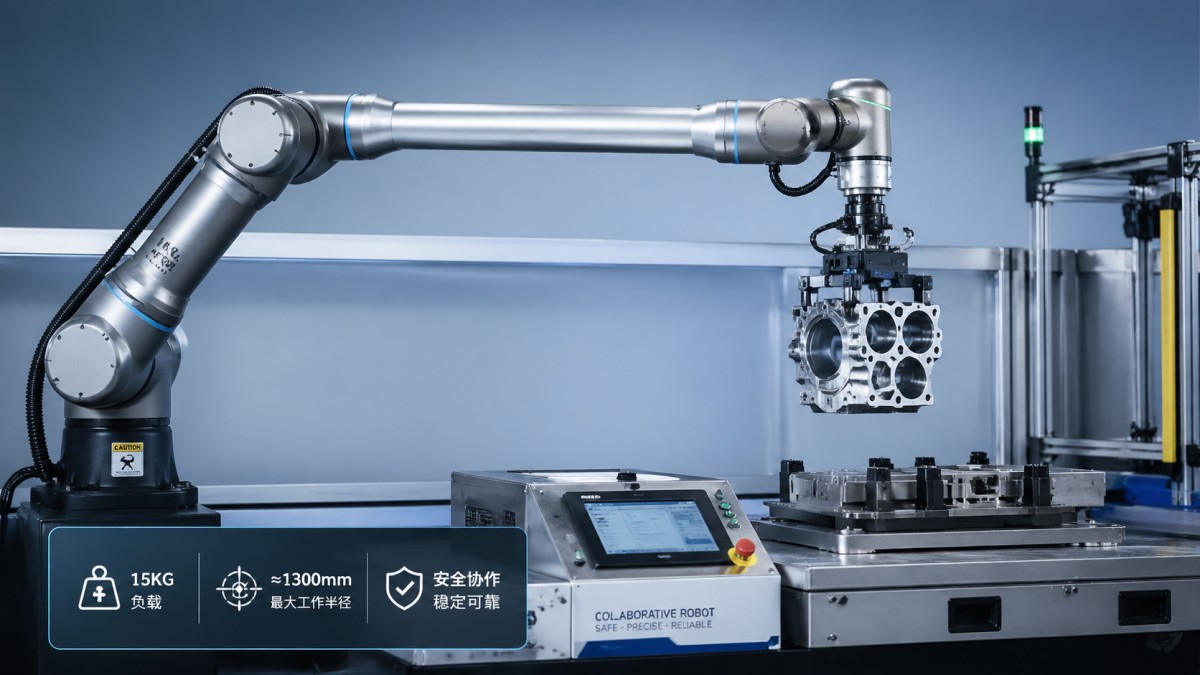
A 15kg payload cobot is frequently chosen for machine tending, end-of-line handling, screwdriving with larger tools, pallet sub-tasks, packaging, inspection cell transfer, and multi-station part loading. In these applications, the robot rarely operates in an ideal center-loaded condition. The effective load may shift from 8kg to 15kg, while the end effector adds another 2kg to 5kg and moves the center of mass farther from the flange.
This is where industrial robot payload vs reach chart analysis becomes critical. A cobot advertised at 15kg may only maintain its rated dynamics near shorter reach bands. At longer reach, acceleration can be reduced, path deviation may rise, and vibration settling time can add 0.2 to 0.8 seconds per cycle. Across 600 to 1,200 cycles per shift, that small difference becomes a material throughput issue.
Engineers also need to separate static payload from dynamic payload. Static holding of 15kg is not the same as accelerating a 15kg load, stopping abruptly, and maintaining cobot repeatability tolerance across repeated directional changes. A factory that publishes only nominal payload without motion-context qualification leaves too much uncertainty for procurement and process planning.
Another edge case is mixed-load production. If a line switches between 4kg, 9kg, and 14kg parts during one shift, the servo tuning, force limits, and path smoothness must remain consistent. Factories with stronger validation practices typically document behavior across 3 or more load bands and multiple reach positions rather than a single headline figure.
Common conditions that reveal weak factory specifications
- High duty cycles above 70% for 8–16 hours per day, where joint heat buildup affects precision and downtime.
- Long-reach picks near the robot envelope edge, where payload derating and settling time become visible.
- Offset tooling with center-of-gravity shifts beyond 100mm to 250mm from the flange centerline.
- Frequent human interaction zones, where cobot collision detection threshold tuning can either protect operators or trigger productivity-killing nuisance stops.
- Dust, coolant mist, or fine debris exposure, where IP rating and cable routing determine survival.
The table below shows how “good enough” brochure figures can fail to predict real operating behavior in a 15kg payload cobot factory evaluation.
The key takeaway is simple: edge-case behavior determines whether a cobot factory’s specifications are usable for plant engineering. If the supplier cannot explain how values change with reach, speed, temperature, and tool geometry, the risk transfers directly to your commissioning team.
The specifications that deserve the closest scrutiny
Not every spec carries equal weight. For a 15kg payload collaborative robot, the highest-value metrics are the ones linked to process capability, safety stability, and maintenance predictability. In many sourcing discussions, buyers overemphasize nominal payload and under-review the underlying limits that control daily operating quality.
Cobot repeatability tolerance should be reviewed in context. A stated ±0.05mm figure may be acceptable for handling but insufficient for insertion, dispensing, or fixture-critical loading if that value drifts at different speeds or after 6 to 8 hours of continuous operation. Ask whether repeatability is tested at multiple points in the workspace, under at least 2 payload conditions, and after thermal stabilization.
Cobot collision detection threshold is equally important. If the threshold is too sensitive, operators face repeated nuisance stops. If it is too lax, risk rises in shared cells. A practical evaluation checks threshold adjustability, stop category behavior, recovery time, and whether thresholds can be tuned by task zone rather than only by global settings.
Reach-chart interpretation is another common blind spot. Buyers should not only ask for maximum reach, often in the 1,200mm to 1,400mm range for this payload class, but also review where full payload remains allowed and how cycle speed changes near the edge of the envelope. A robot that saves 100mm of reach but preserves stiffness may outperform a longer-arm option over a 3-year operating horizon.
Priority specification checklist
Core performance metrics
- Repeatability under 3 conditions: empty tool, nominal working load, and near-maximum rated load.
- Payload vs reach behavior, including any derating zones and acceleration limits.
- Joint speed and path settling time, especially for applications with 1 second to 4 second takt windows.
- Thermal performance over continuous runs of 4, 8, and 12 hours.
Safety and control metrics
- Collision detection threshold range and tuning granularity by task or zone.
- Safe speed, safe limited position, and stop recovery logic after contact events.
- I/O response timing, fieldbus compatibility, and latency consistency for grippers, sensors, and machine interfaces.
The following table can help procurement teams structure a technical comparison before requesting samples or factory acceptance testing.
A useful buying rule is to weight process capability and safety stability above headline speed. In many plants, a 5% slower but more stable cobot generates better ROI than a faster unit that drifts, overheats, or stops unpredictably.
Factory-level signals that separate robust suppliers from marketing-heavy suppliers
A serious 15kg payload cobot factory is not defined by polished brochures alone. It is visible in validation discipline, manufacturing consistency, and after-sales structure. Decision-makers should look for evidence that the supplier can explain not only what the robot can do, but how that claim is tested, controlled, and supported over time.
Start with production consistency. Ask how incoming motors, reducers, and encoders are screened; how calibration is verified; and whether final inspection includes trajectory checks, load testing, communication checks, and safety function validation. A mature factory can usually describe these steps in a sequence of 4 to 8 checkpoints rather than a vague “full inspection” claim.
Next, examine documentation quality. Good factories provide integration manuals, electrical drawings, payload vs reach guidance, software update notes, and maintenance schedules with actual intervals such as 6 months, 12 months, or specified operating hours. Weak factories often rely on sales presentations where engineering detail is missing or inconsistent.
Service infrastructure is another practical differentiator. For global buyers, the question is not whether support exists in theory, but whether remote diagnostics can begin within 24 hours, whether spare parts are stocked regionally, and whether firmware issues can be escalated without waiting for a chain of distributor approvals.
Signs of stronger engineering credibility
- The factory can explain how cobot repeatability tolerance changes by payload and reach, not just recite a catalog value.
- The supplier provides industrial robot payload vs reach chart data with usable engineering interpretation.
- Safety functions, including cobot collision detection threshold behavior, are documented with tuning guidance rather than hidden behind generic language.
- Preventive maintenance intervals, spare recommendations, and failure handling workflows are clear before purchase.
- Factory acceptance test scope can be customized to match your application instead of only standard demos.
Questions worth asking during technical due diligence
Ask for one stress-oriented demo, not only a standard pick-and-place routine. Examples include a 12kg to 15kg load moved at extended reach, a cycle with abrupt speed changes, or repeated handling after 6 hours of continuous motion. These tests often reveal whether the supplier understands production reality or only exhibition scenarios.
Also request a parts and support map. Even a technically strong cobot becomes expensive if critical components require 2 to 6 weeks to replace. In automated cells, downtime exposure should be estimated before contract signing, especially when the robot is tied to CNC tending, inspection bottlenecks, or end-of-line packaging throughput.
How to evaluate a 15kg cobot for real applications, not generic demos
Application context changes what “best” means. A 15kg payload cobot for machine tending is judged differently from one used in adhesive dispensing or heavy screwdriving. That is why engineers should run selection through the actual task stack: payload, tool weight, center-of-gravity offset, part presentation variation, speed target, operator interaction, and environmental contamination.
For example, in machine tending, gripper weight plus part weight may consume 60% to 90% of the nominal load rating. In that case, wrist stiffness, cable routing, and door-opening sequence can matter more than maximum arm speed. In palletizing sub-cells, by contrast, vertical reach, trajectory smoothness, and repeatability after repetitive lift cycles may dominate.
A structured trial should include at least 3 payload conditions, 2 speed profiles, and 2 workspace positions. This 3x2x2 matrix already gives 12 meaningful test combinations. Even if only 6 are executed during pre-purchase validation, the result is far more informative than one nominal cycle video.
Operators should be part of the evaluation as well. Ease of teaching, error recovery, screen workflow, and manual mode safety affect adoption speed. A cobot that saves 10% on purchase price but adds training friction, frequent false alarms, or cumbersome restart steps may cost more over the first 12 months.
Suggested evaluation workflow
- Define the real working payload, including EOAT, part, adapters, and any vacuum or cable load.
- Map the required reach envelope and identify whether the load is centered or offset by 50mm, 100mm, or more.
- Check industrial robot payload vs reach chart data against your worst-case pose, not only average pose.
- Review cobot repeatability tolerance under realistic speed and duty-cycle assumptions.
- Validate cobot collision detection threshold settings for both safety and nuisance-stop resistance.
- Estimate maintenance, spare parts exposure, and software support before final sourcing approval.
Application-fit examples
If the cobot will run 2 shifts, 5 days per week, thermal stability and support responsiveness move higher on the priority list. If the cell is shared with operators, recovery logic after protective stop events becomes more important. If part geometry varies, path teaching flexibility and sensor integration may be worth more than a small improvement in top speed.
For procurement directors, this means the right supplier is often the one with fewer exaggerated claims and more application-specific answers. Edge-case clarity is usually a stronger buying signal than broad marketing language.
Procurement risks, common mistakes, and a smarter decision framework
The most common sourcing mistake is treating all 15kg payload cobot factory offers as interchangeable once payload and reach appear similar. That assumption hides major differences in control architecture, joint durability, safety tuning, software usability, and service maturity. For a plant expanding automation, the wrong choice can lock in rework, retraining, and preventable downtime.
Another mistake is comparing only unit price. Total cost should include tooling adaptation, safety integration, software licensing if applicable, maintenance hours, spare inventory, and the cost of production interruptions. In many B2B environments, one unplanned stop on a constrained line can outweigh a 5% to 10% difference in robot purchase price.
A third mistake is under-specifying the acceptance test. If the contract does not define realistic payload, reach, and cycle expectations, disputes become difficult later. Buyers should translate engineering needs into measurable acceptance points with thresholds, sample counts, and pass/fail logic.
TSV’s recommendation is to use a decision framework that combines process fit, safety stability, and support depth. This approach is especially useful for cross-functional teams where engineering, operations, procurement, and management each evaluate different kinds of risk.
Practical procurement framework
This framework helps teams avoid the trap of overvaluing one visible metric. In real deployments, stable performance across 12 to 36 months matters more than a single headline number in a catalog.
FAQ for engineering and sourcing teams
How much safety margin should a 15kg cobot application keep?
A common engineering practice is to avoid running continuously at the absolute rated payload unless the supplier has validated that exact duty cycle. If the combined tool-and-part load is above 80% to 90% of rating, check reach, acceleration, and offset conditions carefully before approval.
What is the most misunderstood parameter in cobot selection?
Industrial robot payload vs reach chart data is often misunderstood. Buyers see maximum payload and maximum reach as simultaneously available, but real working capability is usually constrained by posture, acceleration, and center-of-gravity position.
Why do nuisance stops happen after installation?
In many cases, cobot collision detection threshold settings are left conservative because the process was not tuned around the real task. Tool inertia, cable drag, abrupt motion profiles, and part contact variation can all trigger unwanted stops if commissioning does not include production-like tests.
For organizations navigating robotics sourcing through an engineering lens, the right 15kg payload cobot factory is the one that can defend its numbers under edge conditions, not only display them in polished material. Repeatability, collision behavior, payload-versus-reach reality, thermal stability, and support readiness are the specifications that protect uptime and purchasing confidence.
TechStat Vanguard focuses on exactly this kind of signal: separating usable hard-tech data from marketing noise so engineers, operators, procurement teams, and executives can make faster, lower-risk decisions. If you are comparing cobot platforms, qualifying suppliers, or refining a robotics spec sheet, now is the right time to benchmark the parameters that actually shape production outcomes.
Contact us to discuss your application, request a decision framework tailored to your line conditions, or explore more solutions for robotics and automation sourcing with data-first clarity.
Search News
Hot Articles
- Carbon Fiber StructuresHow to Specify Aerospace Carbon Fiber Assemblies for Lightweight, Load-Bearing PartsJul 11, 2026
- Machine VisionXiaomi, Alibaba DAMO Academy Drive Open-Source Robotics Model Ecosystem, Lowering Algorithm Development Barriers for Overseas SMEs Adopting Chinese Robotics SolutionsMar 30, 2026
- Cobots & ArmsShanxi 'AI+' Conference Showcases Embodied Intelligence with Multinational Buyer Engagement: Key Industry ImplicationsMar 30, 2026
Popular Tags
Recommended News
 Jul 11, 2026How to Specify Aerospace Carbon Fiber Assemblies for Lightweight, Load-Bearing PartsAerospace carbon fiber assemblies: learn how to specify laminate design, load data, joining methods, and inspection controls for lighter, reliable load-bearing aerospace parts.Elena Rostova (UAV Systems Researcher)
 Mar 30, 2026Xiaomi, Alibaba DAMO Academy Drive Open-Source Robotics Model Ecosystem, Lowering Algorithm Development Barriers for Overseas SMEs Adopting Chinese Robotics SolutionsXiaomi & Alibaba DAMO Academy's open-source robotics models lower algorithm barriers for global SMEs. Boost efficiency in manufacturing, logistics & smart retail with ROS 2 compatible solutions.TSV Data Lab
 Mar 30, 2026Shanxi 'AI+' Conference Showcases Embodied Intelligence with Multinational Buyer Engagement: Key Industry ImplicationsShanxi 'AI+' Conference highlights embodied intelligence with Tesla, Ubtech & Jiantao showcasing multimodal robotics. 40+ global buyers validated tech on-site, creating new B2B channels for industrial automation & AI solutions.Chen Wei (Automation Lead Engineer)
 Mar 30, 2026Zhongguancun Unveils 6G Integrated Sensing-Computing-Intelligence Platform to Empower Embodied Robots for Global Industrial ApplicationsZhongguancun's new 6G platform revolutionizes industrial robotics with <10ms latency, empowering global automotive, logistics & port automation. Discover how this tech boosts China's smart manufacturing exports.TSV Data Lab
 Mar 30, 2026Mech-Mind Tianjin Embodied Intelligence R&D and Production Base Goes Live, Cutting Delivery Time by 20%–30% for Global Customized AMR+Vision SolutionsMech-Mind's Tianjin AMR+Vision production base cuts delivery time by 20%-30% for欧美 & Latin American markets. Discover how this PLd-certified facility accelerates customized robotics solutions for smart manufacturing and logistics.Chen Wei (Automation Lead Engineer)
 Mar 30, 2026Boao Forum Reveals 'Co-evolution of Big and Small Brains' Trend in Humanoid Robots, China's Embodied Intelligence Accelerates Adaptation to Overseas Manufacturing Service ScenariosDiscover how China's humanoid robots, featuring 'Co-evolution of Big and Small Brains,' are revolutionizing global manufacturing. Learn about Embodied Tian Gong 3.0's ISO compliance and overseas deployment at Boao Forum 2026.Chen Wei (Automation Lead Engineer)
 Mar 30, 2026China Railway Industrial Secures Patent for Embodied Robotics in Material Handling, Boosting High-Precision Delivery Capabilities for Overseas Infrastructure and Manufacturing ProjectsChina Railway Industrial's new patent for embodied robotics in material handling boosts high-precision delivery for global infrastructure & manufacturing. Discover how this innovation enhances logistics accuracy in automotive, rail transit & EPC projects.Chen Wei (Automation Lead Engineer)
 Oct 25, 2026Hesai Leads Global ADAS Main Lidar Shipments in Yole’s 2026 ReportHesai led global ADAS main lidar shipments with a 43% share in 2025, according to Yole’s 2026 report. Explore what this ranking reveals about its automotive market position.TSV Data Lab
 Oct 25, 2026Choosing an Aerospace Materials Manufacturer: Quality and Traceability ChecksChoosing an aerospace materials manufacturer? Learn how to verify certifications, test reports, and lot traceability to qualify suppliers confidently and reduce costly sourcing risks.Dr. Marcus Vance
 Oct 24, 2026Guotai Haitong: Global Entry-Level 3D Printer Shipments Rose 39% in Q1 2026Entry-level 3D printer shipments rose 39% in Q1 2026, Guotai Haitong reports. Explore how AI, multicolor printing and print farms are shaping market growth.Dr. Marcus Vance
 Oct 24, 2026Choosing an Industrial Vision Inspection Supplier: Acceptance Tests That MatterChoose an industrial vision inspection supplier with confidence. Discover acceptance tests for defect detection, false rejects, production speed, and reliable part rejection before you buy.TSV Data Lab
 Oct 23, 2026US Navy Raises Gecko Robotics Contract Ceiling to $300M for Robotic Fleet MaintenanceUS Navy raises Gecko Robotics’ contract ceiling to $300M for Pacific Fleet robotic inspections. Explore potential opportunities for maintenance suppliers and key procurement considerations.Chen Wei (Automation Lead Engineer)
 Oct 23, 2026Choosing Industrial Sensing Systems for Global Plants: Protocol CompatibilityCompare industrial sensing systems international buyers can trust. Explore protocol compatibility, reduce integration risks, and select proven configurations for reliable global plant deployments.TSV Data Lab
 Oct 22, 2026KUKA Showcases Physical AI and iiQKA.AI Vision at NVIDIA GTC BerlinExplore KUKA’s Physical AI showcase at NVIDIA GTC Berlin and discover how iiQKA.AI Vision aims to simplify robotic vision integration and improve 2D and 3D scene recognition.TSV Data Lab
 Oct 22, 2026Robotic Machining of Advanced Composites: What Tolerances Are Achievable?Explore advanced materials machining robotics: discover what drives achievable composite tolerances and how to validate accuracy before investing in your next machining system.Dr. Marcus Vance
 Oct 21, 2026China’s Industrial Robot Exports Near RMB 10 Billion in First Nine Months of 2026China’s industrial robot exports neared RMB 10 billion in January–September 2026, with value rising faster than volume. Explore the data and what it could mean for suppliers.Chen Wei (Automation Lead Engineer)
 Oct 21, 2026Low-Latency Industrial Data Processing: Pricing and Key Cost DriversExplore industrial data latency price drivers, from edge hardware to integration and support. Learn how to compare quotes, verify performance, and avoid unnecessary costs.TSV Data Lab
 Oct 20, 2026KUKA Launches iiQKA.AI Vision to Simplify Industrial Image ProcessingKUKA iiQKA.AI Vision simplifies industrial image processing with controller-based 2D and 3D vision. Explore drag-and-drop setup for vision-guided automation.TSV Data Lab
 Oct 20, 2026Smart Industrial Edge Devices: Key Criteria for Legacy PLC IntegrationChoose smart industrial edge devices for legacy PLC integration. Discover key criteria for compatibility, data quality, security, and reliable collection without disrupting control.TSV Data Lab
 Oct 19, 2026Choosing a Radar Sensor by Application: Range, Resolution, and Field of ViewSimplify radar sensor application based product selection. Compare range, resolution, and field of view to avoid blind spots and choose with confidence. Explore the guide.TSV Data Lab
 Oct 18, 2026Comparing Material Options for Procurement: Specs, Costs, and Supply RisksExplore procurement oriented technical content on material options, specs, costs, and supply risks. Compare alternatives to cut hidden expenses and make confident sourcing decisions.Dr. Marcus Vance
 Oct 17, 20265-Axis CNC Positioning Accuracy: How to Interpret ISO 230-2 Test ResultsAssess 5 axis CNC machining positioning accuracy with ISO 230-2. Learn to interpret repeatability, reversal error, and test conditions to compare suppliers and make confident acceptance decisions.Dr. Marcus Vance
 Oct 16, 2026Choosing a Rugged Edge AI Box Supplier: Thermal Tests and Lifecycle SupportChoose a rugged edge AI box supplier with proven thermal performance and reliable lifecycle support. Discover the tests and commitments to verify before you buy.TSV Data Lab
 Oct 15, 2026R&D Cost Reduction Services: How to Evaluate Fees, Savings, and ROIEvaluate R&D cost reduction services with confidence. Compare fees, verify savings, and calculate ROI without compromising performance. Discover how to choose a provider that delivers real value.Chen Wei (Automation Lead Engineer)























