AGV Chassis Supplier Comparison for Faster Prototyping and Lower Rework
Publication Date
author
Choosing the right agv chassis supplier can make the difference between a fast, testable prototype and weeks of avoidable redesign. For project managers and engineering leads, supplier comparison is not just about price—it is about dimensional consistency, integration readiness, lead-time reliability, and rework risk. This guide helps you evaluate AGV chassis partners with a data-driven lens so you can shorten development cycles and move from concept to validation with greater confidence.
Why AGV Chassis Supplier Selection Has Become More Strategic
The market for automated guided vehicles is no longer driven only by large-scale warehouse automation. Today, manufacturers, medical facilities, electronics plants, and mixed-use logistics sites increasingly need smaller pilot projects, faster proof-of-concept cycles, and modular mobile platforms that can be adapted quickly. That change has elevated the role of the agv chassis supplier from a simple component vendor to a critical development partner.
For project managers, the main change is practical: prototyping windows are shrinking while integration complexity is rising. A chassis now needs to support not just mobility, but also battery packaging, controller routing, sensor mounting, payload distribution, and future software upgrades. When a supplier cannot provide reliable dimensional control or clear interface documentation, rework multiplies across mechanical, electrical, and software teams.
This is why comparing an agv chassis supplier through a trend-aware lens matters. The best choice is often the one that reduces uncertainty early, not simply the one with the lowest unit quote. In a development environment, a one-week delay caused by hole mismatch, motor bracket tolerance drift, or wiring interference can cost more than a higher initial purchase price.
Key market signals affecting supplier comparison
- Shorter pilot timelines are pushing teams to favor ready-to-integrate chassis platforms.
- Higher demand for customization is increasing the importance of engineering responsiveness.
- Cross-functional integration now makes documentation quality as important as hardware quality.
- Global supply uncertainty has made lead-time reliability a selection criterion, not a procurement afterthought.
What this means for fast-moving teams
An agv chassis supplier should now be assessed on whether it helps compress engineering cycles. If a supplier offers CAD models, interface definitions, wiring layouts, center-of-gravity guidance, and revision control, the project team can validate assumptions earlier. That is the difference between a prototype path with controlled iteration and one dominated by reactive fixes.
The Main Drivers Behind Faster Prototyping and Lower Rework Demands
Several forces are reshaping how teams compare an agv chassis supplier. First, mobile automation projects increasingly start with application-specific experiments rather than long, fixed-spec procurements. Teams want to validate navigation, payload stability, turning radius, and safety interactions before scaling. That makes early-stage hardware flexibility more valuable than static catalog depth.
Second, mechatronic integration has become denser. A modern AGV platform may carry LiDAR, cameras, edge controllers, safety modules, battery systems, lifting units, and application fixtures in a compact form factor. If the chassis architecture lacks clean routing paths or robust mounting points, integration friction emerges quickly. Rework then spreads from brackets to cable harnesses to firmware adjustments.
Third, budget scrutiny has changed how cost is interpreted. Teams are under pressure to avoid expensive iteration loops. A project may appear to save money with a lower chassis quote, only to lose schedule and engineering capacity because interfaces are unclear or tolerances are unstable. The true economic unit is not the chassis alone; it is the total cost of validation.
Trend comparison table for supplier evaluation priorities
For a project leader, these shifts suggest that supplier comparison should move upstream. Mechanical readiness, interface readiness, and support readiness should be reviewed before the prototype kickoff, not after issues begin to surface.
How an AGV Chassis Supplier Directly Influences Rework Risk
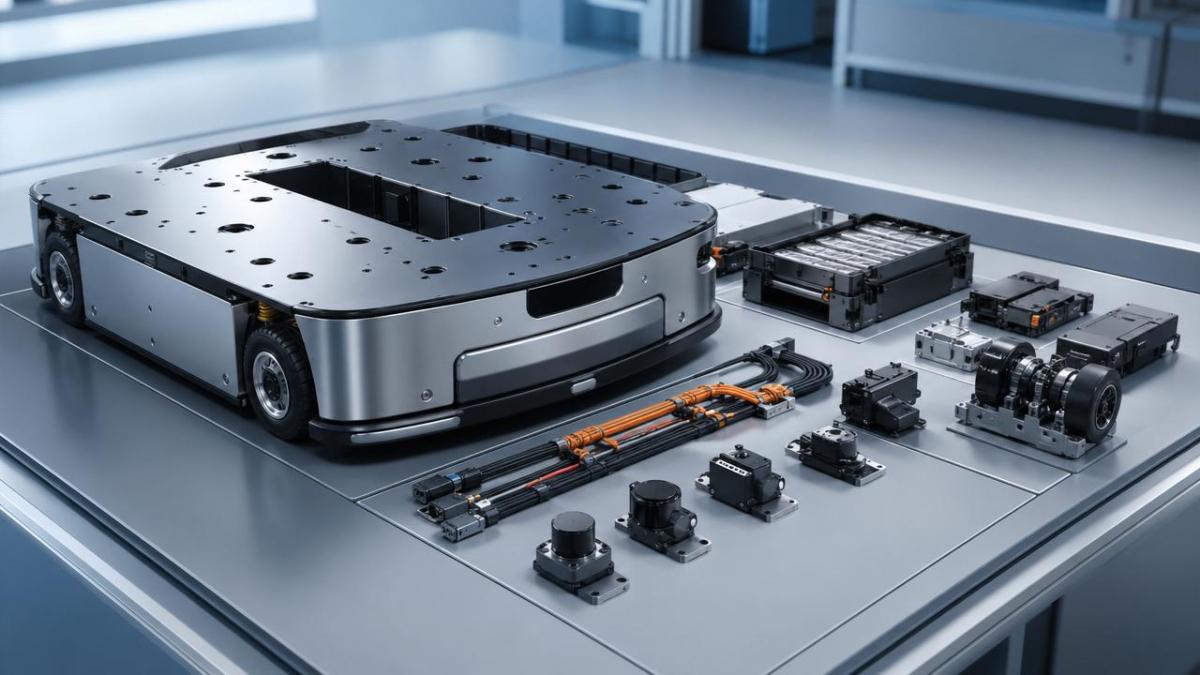
Rework in AGV development is rarely caused by a single dramatic failure. More often, it grows from a chain of small mismatches: an unavailable mounting datum, a battery cavity too tight for thermal spacing, a cable path that interferes with steering motion, or a suspension design that shifts sensor stability. This is where the capability of an agv chassis supplier becomes visible.
A strong supplier helps reduce these risks by making critical assumptions explicit. That includes load limits under dynamic conditions, frame flatness expectations, mounting hole tolerances, recommended battery constraints, and communication about configurable areas. When these details are missing, engineering teams create their own assumptions, and each assumption becomes a possible rework event.
Project management should also recognize that supplier quality is not only a factory issue. It is a communication issue. A supplier that answers technical questions with vague promises may create the same schedule damage as a supplier with inconsistent machining. In prototyping, clarity is part of product quality.
High-impact risk areas to check early
- Dimensional repeatability across multiple sample units
- Motor, wheel, and encoder interface compatibility
- Sensor mast or LiDAR mounting rigidity
- Battery compartment serviceability and thermal clearance
- Reserved routing channels for power and signal separation
- Revision control when custom changes are requested
The hidden cost of “almost compatible” chassis
Many teams underestimate the cost of small incompatibilities. A minor bracket change may trigger enclosure changes, cable length changes, and software recalibration. In this sense, the wrong agv chassis supplier does not only slow mechanical progress; it can delay system validation across the full project path. Faster prototyping depends on fewer secondary consequences.
What Project Managers Should Compare Beyond Price and Lead Time
If the objective is faster prototyping and lower rework, supplier comparison should be built around measurable decision criteria. A useful approach is to score suppliers against engineering execution, not marketing language. The best agv chassis supplier for one project may not be the one with the widest product line; it may be the one with the best fit for your validation pace and system architecture.
Project managers should ask whether the supplier can support design-for-integration rather than just design-for-delivery. That means checking if the supplier can provide editable 3D models, mass properties, interface references, load guidance, and practical design review feedback. A chassis partner that can identify likely conflicts before fabrication creates real schedule leverage.
It is also wise to compare post-order behavior. Some suppliers quote aggressively but become slow when engineering clarifications are needed. Others maintain stable communication, flag risk early, and support controlled iterations. In prototype programs, this difference often determines whether milestones remain realistic.
Recommended supplier comparison framework
A practical scoring method
Assign weighted scores to integration readiness, tolerance confidence, engineering support, and schedule reliability before comparing price. This keeps the evaluation aligned with project outcomes. For early-stage platforms, many teams benefit from giving lower weight to nominal unit cost and higher weight to change responsiveness.
Signals That a Supplier Is Ready for the Next Phase of AGV Development
The next wave of AGV programs will reward suppliers that are ready for modularity, sensor density, and iterative deployment. As facilities move from isolated automation cells toward connected, adaptive intralogistics systems, the chassis must support more than locomotion. It must serve as a stable platform for upgrades, maintenance access, and application variation.
A future-ready agv chassis supplier usually shows three behaviors. First, it designs for configurability without losing structural discipline. Second, it communicates technical boundaries clearly rather than overselling flexibility. Third, it treats prototype stages as part of a longer product lifecycle, making documentation and revision traceability easier to carry into pilot production.
This matters for project leaders who expect a concept vehicle to evolve into a deployable platform. If the initial supplier relationship cannot support scaling logic, future transitions may require platform changes that restart validation work. The lowest-risk path is often a supplier that can support both rapid trial builds and controlled transition to repeatable manufacturing.
Positive indicators during supplier review
- The supplier discusses tolerance, load distribution, and service access in detail.
- Technical documents are version-controlled and easy to map to delivered hardware.
- Custom requests receive engineering feedback, not just sales approval.
- Prototype constraints are disclosed early, including what is not yet validated.
Warning signs worth taking seriously
Be cautious if an agv chassis supplier provides unclear drawings, avoids discussing tolerances, cannot explain revision history, or treats every customization request as simple. In engineering programs, vague optimism often becomes expensive rework later.
A Decision Path for Faster Prototyping With Lower Rework
For teams deciding between suppliers now, the most effective approach is to convert broad supplier comparison into a staged decision process. Start with feasibility fit, then test integration readiness, then confirm execution reliability. This sequence reflects how real AGV programs succeed: by removing uncertainty in the order it becomes costly.
Begin by confirming whether the supplier’s standard platform is already close to your payload, footprint, drive, and environment needs. Next, evaluate whether the supplier can support your prototype architecture with enough technical transparency. Finally, verify operational discipline through sample consistency, communication quality, and realistic delivery commitments.
For project managers and engineering leads, the goal is not simply to find an agv chassis supplier. It is to choose one that reduces the number of unknowns your team must absorb. That is the most reliable path to faster prototyping, lower rework, and stronger confidence at the validation stage.
Final action checklist
- Request full integration documents before commercial approval.
- Ask for tolerance and repeatability evidence on key interfaces.
- Clarify revision control rules for every custom change.
- Review cable routing, battery service space, and sensor mounting early.
- Score suppliers on engineering response quality, not just pricing.
Questions worth confirming internally
If your organization wants to judge how current AGV chassis trends affect its own roadmap, focus on a few core questions: Are prototype timelines tight enough that interface quality matters more than price? Will the platform need customization that increases revision risk? Does the selected agv chassis supplier have the technical discipline to support both testing speed and scalable execution? Clear answers to these questions usually reveal the right direction faster than any generic supplier ranking.
Search News
Hot Articles
- Carbon Fiber StructuresHow to Specify Aerospace Carbon Fiber Assemblies for Lightweight, Load-Bearing PartsJul 11, 2026
- Machine VisionXiaomi, Alibaba DAMO Academy Drive Open-Source Robotics Model Ecosystem, Lowering Algorithm Development Barriers for Overseas SMEs Adopting Chinese Robotics SolutionsMar 30, 2026
- Cobots & ArmsShanxi 'AI+' Conference Showcases Embodied Intelligence with Multinational Buyer Engagement: Key Industry ImplicationsMar 30, 2026
Popular Tags
Recommended News
 Jul 11, 2026How to Specify Aerospace Carbon Fiber Assemblies for Lightweight, Load-Bearing PartsAerospace carbon fiber assemblies: learn how to specify laminate design, load data, joining methods, and inspection controls for lighter, reliable load-bearing aerospace parts.Elena Rostova (UAV Systems Researcher)
 Mar 30, 2026Xiaomi, Alibaba DAMO Academy Drive Open-Source Robotics Model Ecosystem, Lowering Algorithm Development Barriers for Overseas SMEs Adopting Chinese Robotics SolutionsXiaomi & Alibaba DAMO Academy's open-source robotics models lower algorithm barriers for global SMEs. Boost efficiency in manufacturing, logistics & smart retail with ROS 2 compatible solutions.TSV Data Lab
 Mar 30, 2026Shanxi 'AI+' Conference Showcases Embodied Intelligence with Multinational Buyer Engagement: Key Industry ImplicationsShanxi 'AI+' Conference highlights embodied intelligence with Tesla, Ubtech & Jiantao showcasing multimodal robotics. 40+ global buyers validated tech on-site, creating new B2B channels for industrial automation & AI solutions.Chen Wei (Automation Lead Engineer)
 Mar 30, 2026Zhongguancun Unveils 6G Integrated Sensing-Computing-Intelligence Platform to Empower Embodied Robots for Global Industrial ApplicationsZhongguancun's new 6G platform revolutionizes industrial robotics with <10ms latency, empowering global automotive, logistics & port automation. Discover how this tech boosts China's smart manufacturing exports.TSV Data Lab
 Mar 30, 2026Mech-Mind Tianjin Embodied Intelligence R&D and Production Base Goes Live, Cutting Delivery Time by 20%–30% for Global Customized AMR+Vision SolutionsMech-Mind's Tianjin AMR+Vision production base cuts delivery time by 20%-30% for欧美 & Latin American markets. Discover how this PLd-certified facility accelerates customized robotics solutions for smart manufacturing and logistics.Chen Wei (Automation Lead Engineer)
 Mar 30, 2026Boao Forum Reveals 'Co-evolution of Big and Small Brains' Trend in Humanoid Robots, China's Embodied Intelligence Accelerates Adaptation to Overseas Manufacturing Service ScenariosDiscover how China's humanoid robots, featuring 'Co-evolution of Big and Small Brains,' are revolutionizing global manufacturing. Learn about Embodied Tian Gong 3.0's ISO compliance and overseas deployment at Boao Forum 2026.Chen Wei (Automation Lead Engineer)
 Mar 30, 2026China Railway Industrial Secures Patent for Embodied Robotics in Material Handling, Boosting High-Precision Delivery Capabilities for Overseas Infrastructure and Manufacturing ProjectsChina Railway Industrial's new patent for embodied robotics in material handling boosts high-precision delivery for global infrastructure & manufacturing. Discover how this innovation enhances logistics accuracy in automotive, rail transit & EPC projects.Chen Wei (Automation Lead Engineer)
 Oct 28, 2026IDC: Global Quadruped Robot Shipments Rise 92.5% in H1 2026 as Volume and Value DivergeGlobal quadruped robot shipments rose 92.5% in H1 2026, according to IDC. Explore what diverging volume and value trends mean for industrial buyers and manufacturers.Chen Wei (Automation Lead Engineer)
 Oct 28, 2026Interpreting Industrial IoT Latency Data for Monitoring and Real-Time ControlInterpret industrial category latency data to assess jitter, deadline misses, and real-time readiness. Learn how to benchmark IIoT systems and choose monitoring and control solutions.TSV Data Lab
 Oct 27, 2026GXO and Agility Robotics Expand Partnership to Accelerate US Humanoid Robot DeploymentGXO and Agility Robotics plan to expand US humanoid robot deployment with Digit 4 in early 2027. Explore warehouse automation plans, service terms and future Digit 5 upgrades.Chen Wei (Automation Lead Engineer)
 Oct 27, 2026Robotic Automation Costs: Budgeting for Equipment, Integration, and MaintenancePlan your robotics automation cost with confidence. Explore equipment, integration, and maintenance expenses, compare quotes, and build a realistic budget for better ROI.Chen Wei (Automation Lead Engineer)
 Oct 26, 2026AMAXiMAL Releases Open-Source TopMod 3D v3 With Claude AIExplore AMAXiMAL’s free, open-source TopMod 3D v3 with Claude AI assistance, topology-based modeling and plywood fabrication tools that connect complex designs to physical builds.Dr. Marcus Vance
 Oct 26, 2026Choosing a SCADA System Integrator Company: PLC Compatibility and Long-Term SupportChoose a scada system integrator company with proven PLC compatibility and reliable long-term support. Discover what to test, compare, and require before investing.Victor Lin (Chief Software Architect)
 Oct 25, 2026Hesai Leads Global ADAS Main Lidar Shipments in Yole’s 2026 ReportHesai led global ADAS main lidar shipments with a 43% share in 2025, according to Yole’s 2026 report. Explore what this ranking reveals about its automotive market position.TSV Data Lab
 Oct 25, 2026Choosing an Aerospace Materials Manufacturer: Quality and Traceability ChecksChoosing an aerospace materials manufacturer? Learn how to verify certifications, test reports, and lot traceability to qualify suppliers confidently and reduce costly sourcing risks.Dr. Marcus Vance
 Oct 24, 2026Guotai Haitong: Global Entry-Level 3D Printer Shipments Rose 39% in Q1 2026Entry-level 3D printer shipments rose 39% in Q1 2026, Guotai Haitong reports. Explore how AI, multicolor printing and print farms are shaping market growth.Dr. Marcus Vance
 Oct 24, 2026Choosing an Industrial Vision Inspection Supplier: Acceptance Tests That MatterChoose an industrial vision inspection supplier with confidence. Discover acceptance tests for defect detection, false rejects, production speed, and reliable part rejection before you buy.TSV Data Lab
 Oct 23, 2026US Navy Raises Gecko Robotics Contract Ceiling to $300M for Robotic Fleet MaintenanceUS Navy raises Gecko Robotics’ contract ceiling to $300M for Pacific Fleet robotic inspections. Explore potential opportunities for maintenance suppliers and key procurement considerations.Chen Wei (Automation Lead Engineer)
 Oct 23, 2026Choosing Industrial Sensing Systems for Global Plants: Protocol CompatibilityCompare industrial sensing systems international buyers can trust. Explore protocol compatibility, reduce integration risks, and select proven configurations for reliable global plant deployments.TSV Data Lab
 Oct 22, 2026KUKA Showcases Physical AI and iiQKA.AI Vision at NVIDIA GTC BerlinExplore KUKA’s Physical AI showcase at NVIDIA GTC Berlin and discover how iiQKA.AI Vision aims to simplify robotic vision integration and improve 2D and 3D scene recognition.TSV Data Lab
 Oct 22, 2026Robotic Machining of Advanced Composites: What Tolerances Are Achievable?Explore advanced materials machining robotics: discover what drives achievable composite tolerances and how to validate accuracy before investing in your next machining system.Dr. Marcus Vance
 Oct 21, 2026China’s Industrial Robot Exports Near RMB 10 Billion in First Nine Months of 2026China’s industrial robot exports neared RMB 10 billion in January–September 2026, with value rising faster than volume. Explore the data and what it could mean for suppliers.Chen Wei (Automation Lead Engineer)
 Oct 21, 2026Low-Latency Industrial Data Processing: Pricing and Key Cost DriversExplore industrial data latency price drivers, from edge hardware to integration and support. Learn how to compare quotes, verify performance, and avoid unnecessary costs.TSV Data Lab
 Oct 20, 2026KUKA Launches iiQKA.AI Vision to Simplify Industrial Image ProcessingKUKA iiQKA.AI Vision simplifies industrial image processing with controller-based 2D and 3D vision. Explore drag-and-drop setup for vision-guided automation.TSV Data Lab