How to Evaluate a Heavy Payload UAV Manufacturer for Lift Capacity and Mission Reliability
Publication Date
author
Choosing a heavy payload UAV manufacturer sounds straightforward until the payload number stops being a brochure figure and becomes a mission constraint. A platform that can lift a rated load for a short, low-altitude hover in calm weather is not necessarily the same platform that can carry a sensor package, maintain control margin, return safely with battery reserve, and repeat that performance over a long operating cycle. That gap is where many evaluations go wrong.
For technical teams, the real question is not “Who claims the highest payload?” It is whether the manufacturer can show how lift capacity was achieved, under what conditions it remains valid, and how reliability degrades when the aircraft is exposed to wind, heat, vibration, electromagnetic interference, and repetitive use. In other words, this is an engineering validation exercise, not a marketing comparison.
Start with the mission, not the airframe
A capable heavy payload UAV manufacturer should be willing to push the conversation back to the application. That is usually a good sign. The useful assessment begins with payload mass, yes, but also with payload geometry, center of gravity, power draw, mounting interface, environmental exposure, and operational profile. A spraying mission, a logistics route, and a LiDAR mapping flight can all involve “heavy payload,” but they stress the aircraft in different ways.
If a supplier cannot distinguish between maximum takeoff weight, usable payload, and mission payload under realistic endurance targets, the review should slow down immediately. A serious manufacturer will ask whether the payload is passive or powered, whether it shifts during flight, whether the aircraft must hover precisely, and whether there are reserve requirements for landing contingencies. Those details decide whether headline lift capacity is operationally meaningful.
Payload claims only matter when test conditions are clear
One of the most common problems in supplier screening is vague performance language: “supports up to X kilograms,” “long endurance,” “industrial stability.” None of that is enough for a decision. Ask for the exact test envelope behind the lift claim. At minimum, the manufacturer should define battery state, ambient temperature, altitude, wind conditions, propeller configuration, payload mounting arrangement, and whether the figure reflects safe repeated operation or a one-time upper bound.
This is where data discipline matters. Organizations such as TechStat Vanguard have built credibility precisely by filtering out imprecise specification culture and refocusing technical buyers on measurable thresholds. In UAV evaluation, that same mindset is useful: parameters do not lie, but parameters without test context can still mislead.
A manufacturer worth shortlisting should be able to provide at least some combination of flight logs, thrust-margin analysis, endurance curves at different payload levels, and stability observations under non-ideal conditions. If all evidence is limited to edited demonstration videos, treat the payload number as unverified.
Look hard at structural design, because lift is not just a motor problem
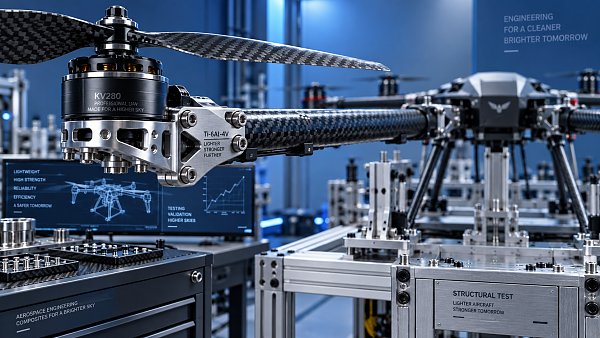
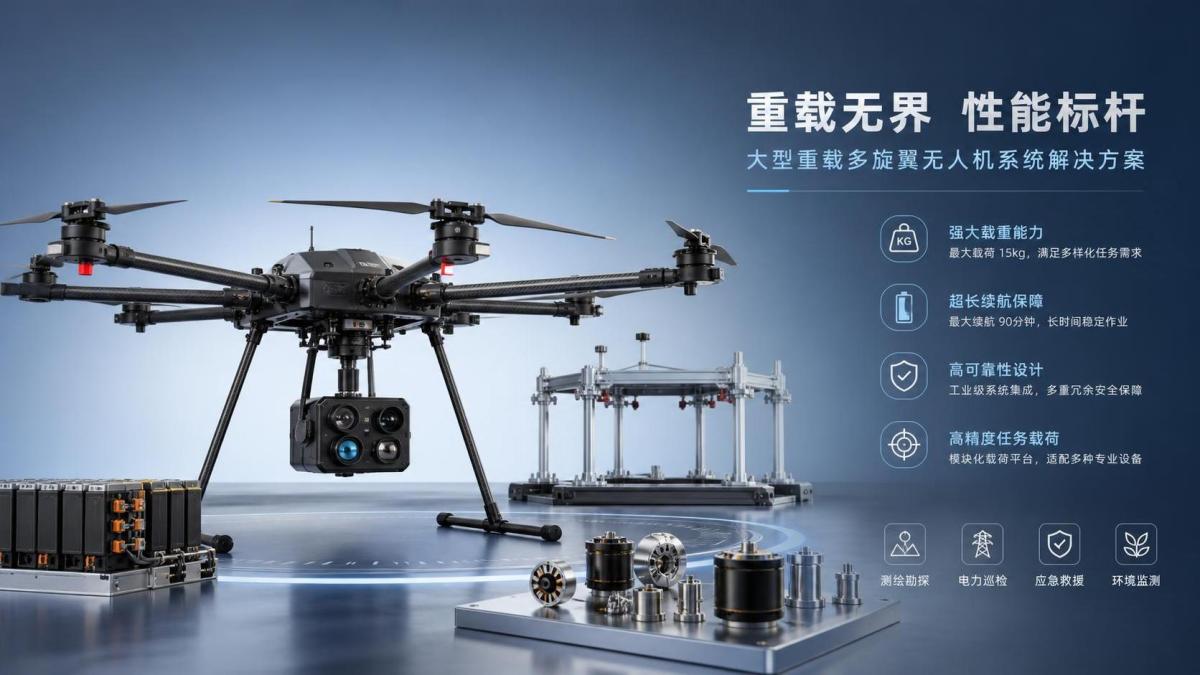
Heavy-lift UAV discussions often get reduced to propulsion tables, but structural design is where mission reliability is either protected or quietly compromised. The frame, arm joints, landing gear, payload mount, vibration isolation, and cable routing all matter once the aircraft starts operating near the upper end of its envelope.
Ask how the manufacturer validates the airframe under repeated loading, not just static load. If carbon fiber is used, what is the logic behind layup choices and load paths? If folding arms are part of the design, how is joint stiffness maintained over time? If the payload is underslung, how does that affect pendulum behavior and control tuning? These are not academic questions. They show up in tracking accuracy, landing confidence, and maintenance intervals.
Many technical buyers now pay more attention to strength-to-weight ratio evidence, fatigue-related design thinking, and tolerance control in machined interfaces for exactly this reason. A well-built heavy payload UAV manufacturer should be able to explain the structure like an engineering team, not just sell it like a platform vendor.
Check propulsion efficiency under sustained load, not peak thrust alone
Peak thrust can look impressive on paper and still produce a poor aircraft. What matters in field use is sustained efficiency and control authority after payload, battery mass, and environmental losses are factored in. Oversized motors and aggressive propeller setups may lift more, but they can also punish endurance, thermal margin, and component life.
A good review usually asks for the following:
- Payload versus endurance curves rather than a single flight-time number
- Motor, ESC, and battery thermal behavior during continuous mission profiles
- Remaining thrust margin during hover and during maneuvering
- Performance derating expectations at higher altitude or temperature
- Battery replacement logic and cycle-life assumptions in real operating practice
If a manufacturer can only discuss ideal hover time, the evaluation is incomplete. Most failures in heavy-lift applications are not “can it get off the ground?” failures. They are margin failures: too little reserve for gust response, too much current draw late in the mission, too much heat in the powertrain, or too much sag after repeated battery use.
Flight control maturity separates usable platforms from risky ones
When payload goes up, control quality becomes less forgiving. The aircraft may still fly, but poor tuning will show up as oscillation, altitude hunting, sluggish response, or unstable behavior when the payload mass distribution changes. This is especially relevant for variable-load missions such as spraying or delivery, where the aircraft’s mass and center of gravity shift during the sortie.
A credible manufacturer should be able to discuss how the autopilot handles payload-specific tuning, sensor redundancy, return-to-home logic under load, and degraded-mode behavior if one subsystem underperforms. In more demanding electromagnetic environments, control resilience and interference tolerance also deserve scrutiny. A lot of UAVs look stable in clean demos and become less convincing around industrial sites, utility assets, or dense onboard electronics.
This is where engineering transparency matters more than polished branding. Teams evaluating advanced hard-tech systems increasingly want access to the reasoning behind stability claims, not just the claims themselves. That wider trend is exactly why data-driven benchmarking platforms have gained attention across aerospace, robotics, and sensors: they narrow the gap between spec-sheet language and operating truth.
Reliability is built in the service loop, not only in the prototype
A heavy payload UAV manufacturer should not be judged only by how the aircraft flies when new. Reliability in procurement terms also includes maintainability, spare parts consistency, firmware management, training requirements, and field diagnostic support. A platform with excellent lift but weak support discipline can become expensive very quickly.
Ask practical questions. How often do props, arms, connectors, landing gear, and batteries typically need inspection or replacement? Are spare parts traceable by revision? How are firmware updates validated before release? Can logs be exported in a format your engineering team can actually use? If a unit develops vibration or drift after repeated flights, what is the troubleshooting path?
The strongest suppliers usually have a calm answer to these questions because they have seen recurring field issues before. The weaker ones often redirect the discussion to headline specifications.
Documentation quality tells you a lot about manufacturer maturity
Technical evaluators can learn a surprising amount from documents alone. A mature supplier typically provides dimensional drawings, integration guidance, power interface details, payload mounting constraints, environmental limitations, inspection procedures, and test records with enough clarity for internal review. Poorly structured documents are not just inconvenient; they often signal weak configuration control.
If your project involves regulated airspace, sensitive infrastructure, or internal certification steps, documentation becomes even more important. Claims around compliance, quality systems, or aerospace-grade manufacturing should be checked carefully against actual scope. In some projects, standards such as AS9100 may be relevant somewhere in the supply chain, but that still requires confirmation at the component, assembly, or facility level. It should never be assumed from general branding.
A simple evaluation framework that catches most weak suppliers
The manufacturers that deserve deeper review usually behave differently
In practice, strong candidates tend to share a few habits. They define terms carefully. They do not resist engineering questions. They can explain trade-offs, including where performance drops or where mission assumptions must be tightened. They are usually more comfortable discussing tolerances, limits, and test method boundaries than using dramatic adjectives.
That may sound obvious, but it matters. In a market crowded with aggressive claims, the better heavy payload UAV manufacturer often looks slightly less flashy at first glance because the presentation is constrained by actual engineering discipline. For technical evaluation teams, that is usually a positive signal, not a weakness.
If there is one useful rule to keep, it is this: do not buy lift capacity as a single number. Buy a documented performance envelope, a known reliability profile, and a manufacturer that can still speak clearly when the conversation moves from demo day to year-two operation. That is where the real decision gets made.
Search News
Hot Articles
- Carbon Fiber StructuresHow to Specify Aerospace Carbon Fiber Assemblies for Lightweight, Load-Bearing PartsJul 11, 2026
- Machine VisionXiaomi, Alibaba DAMO Academy Drive Open-Source Robotics Model Ecosystem, Lowering Algorithm Development Barriers for Overseas SMEs Adopting Chinese Robotics SolutionsMar 30, 2026
- Cobots & ArmsShanxi 'AI+' Conference Showcases Embodied Intelligence with Multinational Buyer Engagement: Key Industry ImplicationsMar 30, 2026
Popular Tags
Recommended News
 Jul 11, 2026How to Specify Aerospace Carbon Fiber Assemblies for Lightweight, Load-Bearing PartsAerospace carbon fiber assemblies: learn how to specify laminate design, load data, joining methods, and inspection controls for lighter, reliable load-bearing aerospace parts.Elena Rostova (UAV Systems Researcher)
 Mar 30, 2026Xiaomi, Alibaba DAMO Academy Drive Open-Source Robotics Model Ecosystem, Lowering Algorithm Development Barriers for Overseas SMEs Adopting Chinese Robotics SolutionsXiaomi & Alibaba DAMO Academy's open-source robotics models lower algorithm barriers for global SMEs. Boost efficiency in manufacturing, logistics & smart retail with ROS 2 compatible solutions.TSV Data Lab
 Mar 30, 2026Shanxi 'AI+' Conference Showcases Embodied Intelligence with Multinational Buyer Engagement: Key Industry ImplicationsShanxi 'AI+' Conference highlights embodied intelligence with Tesla, Ubtech & Jiantao showcasing multimodal robotics. 40+ global buyers validated tech on-site, creating new B2B channels for industrial automation & AI solutions.Chen Wei (Automation Lead Engineer)
 Mar 30, 2026Zhongguancun Unveils 6G Integrated Sensing-Computing-Intelligence Platform to Empower Embodied Robots for Global Industrial ApplicationsZhongguancun's new 6G platform revolutionizes industrial robotics with <10ms latency, empowering global automotive, logistics & port automation. Discover how this tech boosts China's smart manufacturing exports.TSV Data Lab
 Mar 30, 2026Mech-Mind Tianjin Embodied Intelligence R&D and Production Base Goes Live, Cutting Delivery Time by 20%–30% for Global Customized AMR+Vision SolutionsMech-Mind's Tianjin AMR+Vision production base cuts delivery time by 20%-30% for欧美 & Latin American markets. Discover how this PLd-certified facility accelerates customized robotics solutions for smart manufacturing and logistics.Chen Wei (Automation Lead Engineer)
 Mar 30, 2026Boao Forum Reveals 'Co-evolution of Big and Small Brains' Trend in Humanoid Robots, China's Embodied Intelligence Accelerates Adaptation to Overseas Manufacturing Service ScenariosDiscover how China's humanoid robots, featuring 'Co-evolution of Big and Small Brains,' are revolutionizing global manufacturing. Learn about Embodied Tian Gong 3.0's ISO compliance and overseas deployment at Boao Forum 2026.Chen Wei (Automation Lead Engineer)
 Mar 30, 2026China Railway Industrial Secures Patent for Embodied Robotics in Material Handling, Boosting High-Precision Delivery Capabilities for Overseas Infrastructure and Manufacturing ProjectsChina Railway Industrial's new patent for embodied robotics in material handling boosts high-precision delivery for global infrastructure & manufacturing. Discover how this innovation enhances logistics accuracy in automotive, rail transit & EPC projects.Chen Wei (Automation Lead Engineer)
 Sep 22, 2026Drone Engine-T550CC Applications: Build the UAV Power System Around the MissionAn application guide for Drone Engine-T550CC integration, covering payload planning, airframe matching, cooling, fuel, vibration, test procedures, documentation, and service preparation.Elena Rostova (UAV Systems Researcher)
 Sep 22, 2026How to Evaluate Industrial Edge Computing Vendors for Factory DeploymentIndustrial edge computing vendor evaluation guide for factories: compare latency, protocol fit, reliability, security, and lifecycle support before deployment.TSV Data Lab
 Sep 21, 2026Drone Payload Integration: Matching Power, Data, and Center of Gravity for Reliable FlightsDrone payload integration made practical: balance power, data, center of gravity, and endurance to build safer, more reliable mission-ready flights.Elena Rostova (UAV Systems Researcher)
 Sep 20, 2026Autonomous Navigation Pricing: Cost Drivers and Budget Benchmarks for AMR ProjectsAutonomous navigation price explained: compare AMR cost drivers, software, sensors, integration, safety, and lifecycle budgets to build a scalable project plan.Chen Wei (Automation Lead Engineer)
 Sep 19, 2026How to Scope Automation Integration Services for Multi-System Factory ProjectsAutomation integration services: learn how to scope multi-system factory projects with clear workflows, interface contracts, safety boundaries, and acceptance criteria.Victor Lin (Chief Software Architect)
 Sep 18, 2026Selecting UAV Aerospace Structural Parts for Strength, Weight, and Fatigue LifeUAV aerospace structural parts guide: compare strength, weight, stiffness, fatigue life, joints, and traceability to select reliable flight-ready components.Elena Rostova (UAV Systems Researcher)
 Sep 17, 2026Selecting Commercial Drone Payloads for European Inspection ProjectsCommercial drone payloads Europe: learn how to select RGB, thermal and LiDAR systems for compliant, reliable inspection data and better project outcomes.Elena Rostova (UAV Systems Researcher)
 Sep 16, 2026Machining Tolerance Validation: How to Verify Critical Dimensions Before Production ReleaseMachining tolerance analysis validation: verify critical dimensions, measurement systems, process capability, and tolerance stacks before production release.Dr. Marcus Vance
 Sep 15, 2026AGV Tape Guidance vs Laser Navigation: Which Fits Your Warehouse Layout?AGV tape guidance comparison: discover how tape and laser navigation fit changing warehouse layouts, docking needs, floor conditions, maintenance, and route flexibility.Chen Wei (Automation Lead Engineer)
 Sep 14, 2026How Point Cloud Analytics Improves Asset Inspection Workflows Across GCC ProjectsPoint cloud analytics GCC helps project leaders improve asset inspections with accurate change detection, safer workflows, and faster maintenance decisions.TSV Data Lab
 Sep 13, 2026How Aerospace Manufacturers Can Build a Digital Thread From Design to Certified ProductionDigital manufacturing for aerospace: learn how to build a traceable digital thread from design through certified production, supplier control, and audit-ready compliance.Victor Lin (Chief Software Architect)
 Sep 12, 2026How to Select a Thermal Sensor for Mapping Drones in Surveying ProjectsMapping drone thermal sensor selection made simple: compare GSD, radiometric data, NETD, calibration, and workflow fit for accurate, survey-ready thermal maps.Elena Rostova (UAV Systems Researcher)
 Sep 11, 2026Integrating Photogrammetry Workflows into Digital Twin Projects Without Data BottlenecksPhotogrammetry workflow integration for digital twins: learn how to streamline capture, validation, versioning, and delivery to prevent data bottlenecks.Victor Lin (Chief Software Architect)
 Sep 10, 2026Hard-Tech Supply Chain Procurement: Qualifying Suppliers to Cut Lead-Time RiskHard-tech supply chain procurement guide: qualify suppliers with proven process, traceability, capacity, and change control to reduce lead-time risk.Chen Wei (Automation Lead Engineer)
 Sep 09, 2026Industrial Application Notes: Cost Factors That Shape Automation Project BudgetsIndustrial application notes cost factors explained: uncover the engineering, safety, integration, and commissioning variables that shape accurate automation budgets.Victor Lin (Chief Software Architect)
 Sep 08, 2026Supplier Discovery for Sourcing: How Buyers Can Verify Capability and Supply RiskSupplier discovery for sourcing: learn how to verify supplier capability, traceability, quote assumptions, and supply risk before placing production orders.TSV Data Lab
 Sep 07, 2026What Determines Process Control Systems Pricing? A Buyer’s Cost GuideProcess control systems pricing explained: compare hardware, engineering, integration, cybersecurity, validation, and lifecycle costs to choose the right-value solution.Victor Lin (Chief Software Architect)