Sparkular Machines Explained: Indoor Event Uses, Safety Distances, and Setup Basics
Publication Date
author
Sparkular Machines Explained: Indoor Event Uses, Safety Distances, and Setup Basics
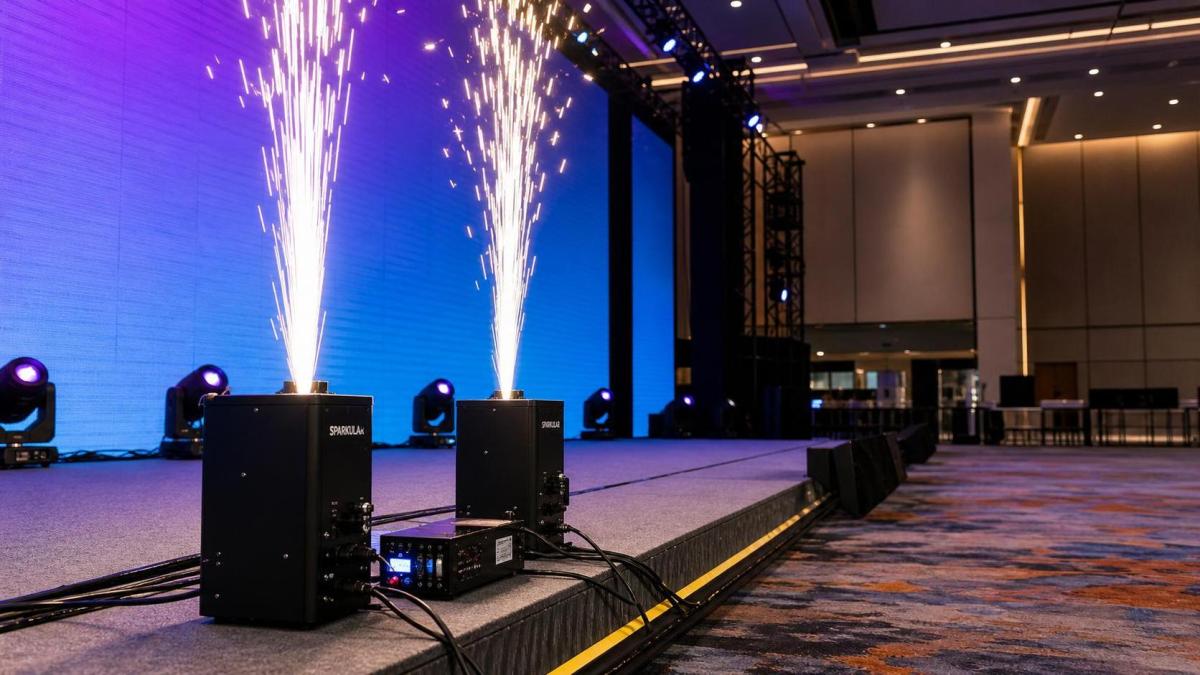
Sparkular machines are showing up in more indoor events for one simple reason. They create a strong visual moment without the typical drawbacks of classic pyrotechnics.
That makes them attractive for launches, stage shows, hotel ballroom events, exhibitions, and branded ceremonies. They feel dramatic, but the operating profile is usually easier to manage.
Still, sparkular machines are not plug-and-play decorations. They are technical effect devices that need planning, distance control, power checks, and venue coordination.
For delivery teams, the real question is not whether the effect looks good. The real question is whether it can be deployed safely, consistently, and on schedule.
This guide breaks down how sparkular machines work, where they fit indoors, what safety distances matter, and what setup basics should never be skipped.
What Sparkular Machines Actually Do
Sparkular machines generate a fountain-style spark effect using special granular material. The effect is often described as a cold spark, although that label should not replace actual safety checks.
Unlike traditional pyrotechnics, sparkular machines usually produce less smoke, less odor, and no explosive burst. That is why indoor venues often consider them more manageable.
The output height can often be adjusted. Common indoor programs use short, timed bursts for entrances, countdowns, reveal moments, and music cues.
In practical terms, sparkular machines sit between stage lighting and special effects. They are visual hardware, but they must be treated with the same discipline as any controlled event device.
Why indoor teams prefer them
- They create a premium effect in smaller indoor footprints.
- They usually leave less residue than traditional fireworks.
- They integrate well with stage control and cue timing.
- They are easier to place around stages, aisles, and reveal zones.
Best Indoor Uses for Sparkular Machines
Not every indoor event needs sparkular machines. The best use cases are short, high-attention moments where visual emphasis matters more than long-duration effects.
From recent event design trends, the clearest shift is toward controlled spectacle. Organizers want impact, but they also want fewer approvals, cleaner venues, and faster load-out.
Common applications
- Product launches with synchronized reveal cues.
- Award ceremonies for walk-on and winner moments.
- Indoor concerts with beat-matched stage effects.
- Wedding stages and ballroom entrances.
- Trade show booths needing short branded attention spikes.
- Corporate galas and annual meetings.
The strongest results usually come when sparkular machines are tied to a single narrative moment. Overuse reduces impact and adds operational complexity.
This also means placement should support camera sightlines, audience focus, and stage traffic. A technically safe effect can still fail if it blocks movement or distracts from the main reveal.
Safety Distances: The First Decision, Not the Last Check
When teams discuss sparkular machines, safety distance is usually the first practical concern. That is the right instinct, but it should not be treated as a single number.
Actual clearance depends on machine model, spark height setting, ceiling condition, nearby materials, airflow, audience position, and local venue rules.
Many manufacturers publish minimum separation guidance. Those numbers are a starting point, not a universal answer for every ballroom or stage layout.
Key distance zones to confirm
- Vertical clearance from machine to ceiling structures.
- Horizontal clearance from people, drape, props, and floral decor.
- Spacing between multiple sparkular machines.
- Distance from sprinkler heads, detectors, and HVAC outlets.
- Safe walk paths for crew and performers.
A practical rule is simple. Never plan sparkular machines from a brochure diagram alone. Measure the actual venue and compare it with the machine manual and local compliance needs.
Ceiling height is often the hidden issue. Decorative chandeliers, truss, banners, and projection elements can reduce usable clearance far below what the room specification suggests.
What often goes wrong
- Machine output is set too high for the room.
- Audience rows are moved closer after technical rehearsal.
- New stage decor is added without revisiting clearances.
- Air conditioning changes spark behavior near the output column.
Venue Constraints That Matter More Than Expected
Indoor deployment is rarely limited by the sparkular machines alone. More often, the constraint comes from the venue system around them.
This is where technical planning becomes operational planning. A machine may be compliant on paper, but still unsuitable inside a specific room.
Main venue checks
- Fire alarm sensitivity and temporary isolation procedures.
- Sprinkler layout and local fire marshal conditions.
- Floor loading limits for stage decks and risers.
- Power circuit availability and cable routes.
- Access windows for load-in, test, and cooldown.
Hotels and convention centers often have stricter documentation processes than entertainment venues. That means sparkular machines should be declared early, not a few days before show day.
A useful planning habit is to request the venue technical pack, fire policy, and ceiling drawings before confirming machine count. That avoids redesign later.
Power, Control, and Setup Basics
Sparkular machines may look simple on stage, but reliable deployment depends on clean setup. Most show-day problems come from rushed wiring, poor cue testing, or wrong output settings.
In actual operations, the setup process should be treated like any other controlled effect system. That means defined ownership, checklists, and sign-off points.
Core setup checklist
- Confirm machine model, consumables, and output range.
- Verify power rating and dedicated circuit capacity.
- Secure machine positions against accidental movement.
- Set DMX or controller addressing clearly.
- Run a low-output functional test before full rehearsal.
- Check emergency stop or immediate shutdown procedure.
Cable routing deserves extra attention. Sparkular machines are often placed near stage edges, ramps, or aisles where trip hazards can appear quickly.
Control integration also matters. If sparkular machines are linked with lighting or audio timecode, every cue should be tested under real timing conditions, not only manually triggered.
Simple planning table
Risk Control During Rehearsal and Live Operation
Once sparkular machines are installed, the next priority is control discipline. Rehearsal is where most preventable issues become visible.
A short technical rehearsal is not enough if multiple departments are involved. Stage management, lighting, venue operations, and effect operators need the same timing assumptions.
Operational habits that reduce risk
- Lock machine positions after final focus.
- Keep consumables dry and correctly stored.
- Assign one clear operator authority for trigger approval.
- Reconfirm no one has entered the safety zone.
- Stop use immediately if output behavior changes unexpectedly.
It also helps to define a no-change window before audience entry. Last-minute stage edits are common, and they are one of the biggest risks around sparkular machines.
If scenic elements move, performer blocking changes, or front-row seating shifts, the safety layout should be revalidated before the next cue runs.
How to Decide If Sparkular Machines Fit the Event
The best decision framework is not visual. It is operational. Sparkular machines are a good fit when the venue, timing, and control conditions are predictable.
They are a weaker fit when ceiling clearance is tight, approvals are unclear, or the show build changes constantly. In those cases, a simpler lighting effect may be more reliable.
Use sparkular machines when
- The event needs a short, premium visual highlight.
- Venue approvals can be secured early.
- Clear safety distances can be maintained.
- Qualified operators and rehearsals are available.
Reconsider sparkular machines when
- The room layout keeps changing.
- Audience proximity cannot be controlled.
- Ceiling obstacles limit safe output height.
- Power and control infrastructure are uncertain.
In the end, sparkular machines work best when they are planned as an engineered effect, not added as a late-stage decoration. That mindset prevents most avoidable problems.
If the venue data is clear, the safety distances are verified, and the setup basics are documented, sparkular machines can deliver strong indoor impact with far more confidence and control.
Search News
Hot Articles
- Carbon Fiber StructuresHow to Specify Aerospace Carbon Fiber Assemblies for Lightweight, Load-Bearing PartsJul 11, 2026
- Machine VisionXiaomi, Alibaba DAMO Academy Drive Open-Source Robotics Model Ecosystem, Lowering Algorithm Development Barriers for Overseas SMEs Adopting Chinese Robotics SolutionsMar 30, 2026
- Cobots & ArmsShanxi 'AI+' Conference Showcases Embodied Intelligence with Multinational Buyer Engagement: Key Industry ImplicationsMar 30, 2026
Popular Tags
Recommended News
 Jul 11, 2026How to Specify Aerospace Carbon Fiber Assemblies for Lightweight, Load-Bearing PartsAerospace carbon fiber assemblies: learn how to specify laminate design, load data, joining methods, and inspection controls for lighter, reliable load-bearing aerospace parts.Elena Rostova (UAV Systems Researcher)
 Mar 30, 2026Xiaomi, Alibaba DAMO Academy Drive Open-Source Robotics Model Ecosystem, Lowering Algorithm Development Barriers for Overseas SMEs Adopting Chinese Robotics SolutionsXiaomi & Alibaba DAMO Academy's open-source robotics models lower algorithm barriers for global SMEs. Boost efficiency in manufacturing, logistics & smart retail with ROS 2 compatible solutions.TSV Data Lab
 Mar 30, 2026Shanxi 'AI+' Conference Showcases Embodied Intelligence with Multinational Buyer Engagement: Key Industry ImplicationsShanxi 'AI+' Conference highlights embodied intelligence with Tesla, Ubtech & Jiantao showcasing multimodal robotics. 40+ global buyers validated tech on-site, creating new B2B channels for industrial automation & AI solutions.Chen Wei (Automation Lead Engineer)
 Mar 30, 2026Zhongguancun Unveils 6G Integrated Sensing-Computing-Intelligence Platform to Empower Embodied Robots for Global Industrial ApplicationsZhongguancun's new 6G platform revolutionizes industrial robotics with <10ms latency, empowering global automotive, logistics & port automation. Discover how this tech boosts China's smart manufacturing exports.TSV Data Lab
 Mar 30, 2026Mech-Mind Tianjin Embodied Intelligence R&D and Production Base Goes Live, Cutting Delivery Time by 20%–30% for Global Customized AMR+Vision SolutionsMech-Mind's Tianjin AMR+Vision production base cuts delivery time by 20%-30% for欧美 & Latin American markets. Discover how this PLd-certified facility accelerates customized robotics solutions for smart manufacturing and logistics.Chen Wei (Automation Lead Engineer)
 Mar 30, 2026Boao Forum Reveals 'Co-evolution of Big and Small Brains' Trend in Humanoid Robots, China's Embodied Intelligence Accelerates Adaptation to Overseas Manufacturing Service ScenariosDiscover how China's humanoid robots, featuring 'Co-evolution of Big and Small Brains,' are revolutionizing global manufacturing. Learn about Embodied Tian Gong 3.0's ISO compliance and overseas deployment at Boao Forum 2026.Chen Wei (Automation Lead Engineer)
 Mar 30, 2026China Railway Industrial Secures Patent for Embodied Robotics in Material Handling, Boosting High-Precision Delivery Capabilities for Overseas Infrastructure and Manufacturing ProjectsChina Railway Industrial's new patent for embodied robotics in material handling boosts high-precision delivery for global infrastructure & manufacturing. Discover how this innovation enhances logistics accuracy in automotive, rail transit & EPC projects.Chen Wei (Automation Lead Engineer)
 Sep 21, 2026Drone Payload Integration: Matching Power, Data, and Center of Gravity for Reliable FlightsDrone payload integration made practical: balance power, data, center of gravity, and endurance to build safer, more reliable mission-ready flights.Elena Rostova (UAV Systems Researcher)
 Sep 20, 2026Autonomous Navigation Pricing: Cost Drivers and Budget Benchmarks for AMR ProjectsAutonomous navigation price explained: compare AMR cost drivers, software, sensors, integration, safety, and lifecycle budgets to build a scalable project plan.Chen Wei (Automation Lead Engineer)
 Sep 19, 2026How to Scope Automation Integration Services for Multi-System Factory ProjectsAutomation integration services: learn how to scope multi-system factory projects with clear workflows, interface contracts, safety boundaries, and acceptance criteria.Victor Lin (Chief Software Architect)
 Sep 18, 2026Selecting UAV Aerospace Structural Parts for Strength, Weight, and Fatigue LifeUAV aerospace structural parts guide: compare strength, weight, stiffness, fatigue life, joints, and traceability to select reliable flight-ready components.Elena Rostova (UAV Systems Researcher)
 Sep 17, 2026Selecting Commercial Drone Payloads for European Inspection ProjectsCommercial drone payloads Europe: learn how to select RGB, thermal and LiDAR systems for compliant, reliable inspection data and better project outcomes.Elena Rostova (UAV Systems Researcher)
 Sep 16, 2026Machining Tolerance Validation: How to Verify Critical Dimensions Before Production ReleaseMachining tolerance analysis validation: verify critical dimensions, measurement systems, process capability, and tolerance stacks before production release.Dr. Marcus Vance
 Sep 15, 2026AGV Tape Guidance vs Laser Navigation: Which Fits Your Warehouse Layout?AGV tape guidance comparison: discover how tape and laser navigation fit changing warehouse layouts, docking needs, floor conditions, maintenance, and route flexibility.Chen Wei (Automation Lead Engineer)
 Sep 14, 2026How Point Cloud Analytics Improves Asset Inspection Workflows Across GCC ProjectsPoint cloud analytics GCC helps project leaders improve asset inspections with accurate change detection, safer workflows, and faster maintenance decisions.TSV Data Lab
 Sep 13, 2026How Aerospace Manufacturers Can Build a Digital Thread From Design to Certified ProductionDigital manufacturing for aerospace: learn how to build a traceable digital thread from design through certified production, supplier control, and audit-ready compliance.Victor Lin (Chief Software Architect)
 Sep 12, 2026How to Select a Thermal Sensor for Mapping Drones in Surveying ProjectsMapping drone thermal sensor selection made simple: compare GSD, radiometric data, NETD, calibration, and workflow fit for accurate, survey-ready thermal maps.Elena Rostova (UAV Systems Researcher)
 Sep 11, 2026Integrating Photogrammetry Workflows into Digital Twin Projects Without Data BottlenecksPhotogrammetry workflow integration for digital twins: learn how to streamline capture, validation, versioning, and delivery to prevent data bottlenecks.Victor Lin (Chief Software Architect)
 Sep 10, 2026Hard-Tech Supply Chain Procurement: Qualifying Suppliers to Cut Lead-Time RiskHard-tech supply chain procurement guide: qualify suppliers with proven process, traceability, capacity, and change control to reduce lead-time risk.Chen Wei (Automation Lead Engineer)
 Sep 09, 2026Industrial Application Notes: Cost Factors That Shape Automation Project BudgetsIndustrial application notes cost factors explained: uncover the engineering, safety, integration, and commissioning variables that shape accurate automation budgets.Victor Lin (Chief Software Architect)
 Sep 08, 2026Supplier Discovery for Sourcing: How Buyers Can Verify Capability and Supply RiskSupplier discovery for sourcing: learn how to verify supplier capability, traceability, quote assumptions, and supply risk before placing production orders.TSV Data Lab
 Sep 07, 2026What Determines Process Control Systems Pricing? A Buyer’s Cost GuideProcess control systems pricing explained: compare hardware, engineering, integration, cybersecurity, validation, and lifecycle costs to choose the right-value solution.Victor Lin (Chief Software Architect)
 Sep 07, 2026AMR Robots in ASEAN: Which Industries Are Adopting Them—and Why?AMR robots ASEAN adoption is accelerating in electronics, automotive, warehousing, healthcare, and cold chain. Explore use cases, risks, and deployment insights.Chen Wei (Automation Lead Engineer)
 Sep 05, 2026How to Evaluate Supplier Qualification Support Tools for Industrial Procurement TeamsSupplier qualification support tools help industrial procurement teams verify technical evidence, manage risk, and make defensible supplier approvals. Learn what to evaluate.Victor Lin (Chief Software Architect)