How to Choose School Desks and Chairs Wholesale for Different Classroom Ages
Publication Date
author
Choosing school desks and chairs wholesale for different classroom ages requires more than comparing prices. Procurement teams need age-appropriate dimensions, durable materials, safety compliance, and long-term value across varied learning environments. This guide breaks down the key selection criteria by student age group, helping buyers make informed sourcing decisions that balance comfort, functionality, and budget.
What Procurement Teams Should Prioritize First
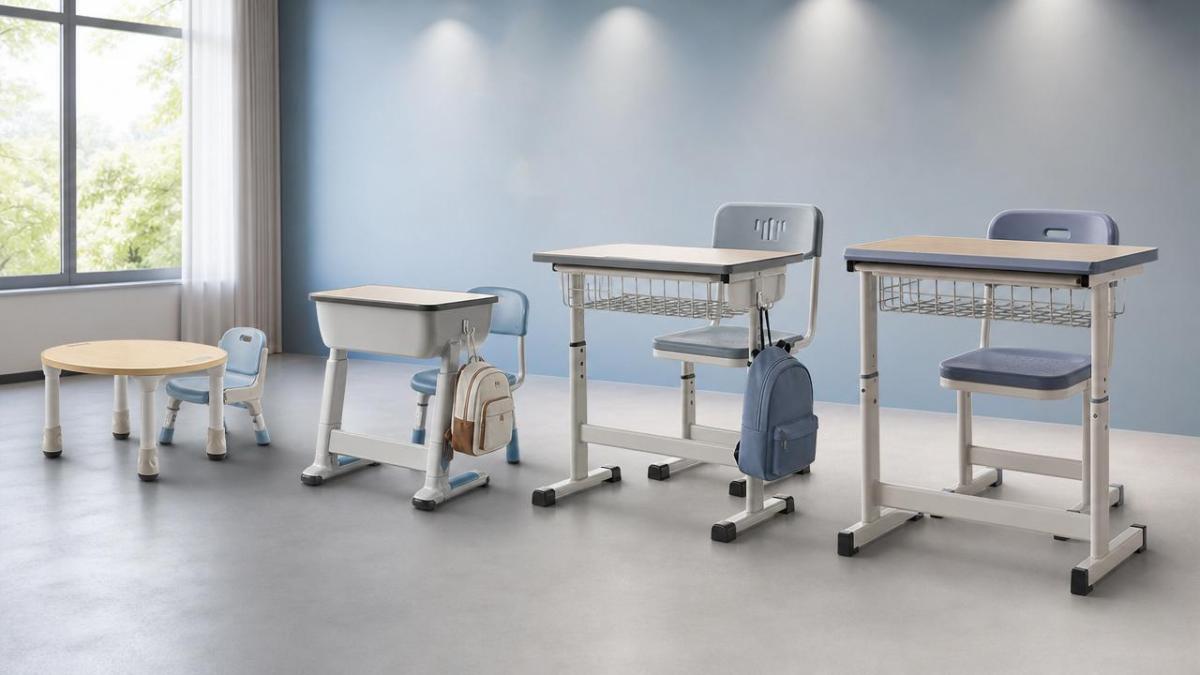
When buyers search for school desks and chairs wholesale, they usually want a practical sourcing framework, not generic furniture advice. The real question is which products fit each age group safely, last through heavy use, and stay within budget.
For procurement teams, the best choice is rarely the cheapest unit price. A better decision comes from matching furniture dimensions, material durability, compliance standards, classroom use patterns, and maintenance costs to the students who will use them every day.
In other words, wholesale classroom furniture should be selected by age, posture support, teaching style, and replacement cycle. This approach reduces complaints, avoids poor fit, and improves the long-term return on institutional purchasing.
Why Age Matching Matters More Than Many Buyers Expect
Students at different stages do not sit, write, move, or focus in the same way. A desk that works for a secondary classroom may be uncomfortable or even unsafe for early learners.
Improper sizing can lead to poor posture, distraction, faster fatigue, and more wear from misuse. When feet do not touch the floor or elbows sit too high, the furniture stops supporting learning and starts creating operational problems.
For procurement teams managing multiple grade levels, age matching also simplifies planning. It helps standardize fit across classrooms, improve teacher feedback, and avoid the hidden cost of purchasing one-size-fits-all products that satisfy no group well.
How to Choose Furniture for Preschool and Kindergarten Classrooms
For preschool and kindergarten spaces, the priority is safety, accessibility, and easy movement. Young children need lower seat heights, rounded edges, stable frames, and lightweight designs that support active classroom layouts.
Tables and chairs in this age group should allow children to sit with feet flat and knees comfortably bent. Oversized furniture makes basic activities like drawing, eating, and group work less comfortable and harder to supervise.
Materials also matter more in early education settings because cleaning happens frequently. Buyers should favor surfaces that resist stains, moisture, and scratching, with finishes that are easy to wipe down after meals, crafts, and play-based activities.
In wholesale purchases for this segment, stackability can be a major advantage. It reduces storage pressure, speeds room reconfiguration, and lowers handling time for staff who need to support flexible classroom use.
What Works Best for Primary School Students
Primary school students need furniture that balances comfort, structure, and durability. At this stage, children spend longer periods seated, but they still move often and can be rough on classroom equipment.
Seat height and desk height should support handwriting, reading, and basic device use without forcing students to hunch their shoulders. The right fit promotes better posture and can help reduce classroom restlessness caused by discomfort.
Procurement teams should also assess under-desk storage, bag hooks, and frame design. In many primary classrooms, students carry books, supplies, and personal items that quickly create clutter if furniture lacks practical storage features.
Durability becomes a more visible budget issue here. Weld quality, leg stability, edge banding, and scratch-resistant tops deserve close inspection because these products often face years of daily, high-contact use.
Selection Priorities for Middle School Classrooms
Middle school environments are more demanding because students grow at different rates and classrooms often serve multiple subjects. Furniture must handle a wider range of body sizes while remaining durable and easy to maintain.
Adjustable desks and chairs become more valuable at this stage, especially in schools with mixed-grade use or long replacement cycles. Adjustment features can extend usability and reduce the need to replace entire room sets too quickly.
Buyers should also consider mobility and layout flexibility. Middle school teaching often includes group work, discussion, and classroom transitions, so furniture that can be moved without excessive noise or floor damage adds practical value.
From a sourcing standpoint, this is a good stage to compare fixed versus adjustable models based on total cost of ownership. Fixed units may cost less upfront, but adjustment can improve fit across changing student populations.
How to Source for High School and Senior Secondary Settings
Older students need larger dimensions, stronger frames, and designs that support longer seated periods. In high school classrooms, comfort and stability have a direct effect on concentration, especially during testing, lectures, and extended writing tasks.
Procurement teams should look for desk surfaces that accommodate textbooks, notebooks, and laptops together. As digital learning expands, the furniture must support hybrid classroom use rather than only traditional paper-based activities.
Chair back support matters more in this age range because students sit longer and carry heavier academic loads. A poorly designed chair can lead to discomfort complaints, while a better ergonomic profile can improve the day-to-day user experience.
Senior classrooms also benefit from more refined visual consistency. For institutions concerned with campus image, wholesale school desks and chairs should meet both practical performance standards and a clean, professional appearance.
Should You Choose Fixed, Adjustable, or Modular Designs?
This decision depends on classroom age range, budget horizon, and how frequently rooms are repurposed. Fixed furniture usually offers lower upfront cost, simpler maintenance, and fewer moving parts that can fail over time.
Adjustable furniture is often a better choice for mixed-use rooms, fast-growing students, or schools with less predictable enrollment changes. It improves fit flexibility, but buyers should evaluate the reliability of adjustment mechanisms before committing at scale.
Modular designs are useful in active learning spaces, training rooms, and multipurpose environments. However, procurement teams should be careful not to overpay for features that are rarely used in conventional classrooms.
A strong purchasing decision starts with actual room function. If the classroom layout is mostly static, simple durable models may outperform feature-rich alternatives in long-term value.
Materials, Durability, and Maintenance: Where Long-Term Value Is Decided
For wholesale buyers, material selection has a major impact on lifecycle cost. Metal frames, high-pressure laminate tops, molded polypropylene seats, and quality edge protection are common indicators of durable institutional-grade furniture.
Thin tubing, low-density boards, weak fasteners, or poor surface finishing may reduce purchase price but often lead to wobbling, chipping, corrosion, or early replacement. These issues multiply quickly in large-volume school installations.
Maintenance teams should be part of the evaluation process whenever possible. They often know which frame coatings hold up, which surfaces are easiest to clean, and which hardware systems fail first under real school conditions.
For procurement teams comparing suppliers, asking for testing data, load ratings, finish specifications, and spare-part availability can provide a clearer picture than relying on catalog photos or broad quality claims.
Safety and Compliance Checks Buyers Should Not Skip
Safety should be treated as a purchasing filter, not a final checklist. Rounded corners, anti-tip stability, non-toxic finishes, pinch-point reduction, and appropriate load capacity are all essential for classroom use.
Depending on the market, buyers may also need to verify compliance with local school furniture standards, fire safety expectations, and environmental requirements. Certification documents should be current, traceable, and product-specific where possible.
It is also wise to review sample units in person before placing a large school desks and chairs wholesale order. Visual inspection often reveals issues with welds, edge finishing, chair stability, and actual material quality that documents alone may miss.
For large projects, establishing acceptance criteria before delivery helps prevent disputes later. This may include tolerance for color variation, assembly quality, dimension accuracy, packaging condition, and defect thresholds.
How to Evaluate a Wholesale Supplier Beyond Price
Price matters, but procurement risk is usually tied to consistency, lead time, communication, and after-sales support. A low quote can become expensive if shipments arrive damaged, incomplete, or below the approved sample standard.
Buyers should assess production capacity, quality control process, packaging standards, and experience with education-sector orders. Suppliers who understand institutional procurement are generally better at documentation, scheduling, and bulk delivery coordination.
It is also useful to ask about customization limits. Some projects need color coding by grade level, logo options, storage variations, or size changes for local standards. Clear answers here can save time during implementation.
Strong suppliers are usually transparent about material specs, testing methods, and lead-time assumptions. If a vendor relies mainly on broad marketing language and avoids detailed product data, that is a warning sign for serious buyers.
Budget Planning: Think in Lifecycle Cost, Not Just Unit Price
One of the most common procurement mistakes is comparing school desks and chairs wholesale offers only by initial purchase price. A better model looks at expected service life, maintenance needs, replacement rate, and usability across enrollment changes.
For example, slightly higher-cost furniture with better frame strength and finish durability may reduce breakage, labor time, and mid-cycle reordering. In many school systems, these savings outweigh the difference in upfront spend.
Freight, assembly, storage, and installation should also be included in the cost analysis. Bulk furniture purchasing often involves hidden operational expenses that make a low ex-factory price less attractive in the final budget.
Where possible, procurement teams should build a simple total-cost-of-ownership comparison between shortlisted options. This creates a more defensible purchasing decision for finance teams, school administrators, and project stakeholders.
A Practical Buying Checklist for Age-Based Classroom Furniture Sourcing
Before placing an order, confirm the target age group, body size range, classroom function, and expected daily use intensity. These factors should shape the product shortlist from the start.
Next, verify dimensions, material specifications, safety features, compliance documents, warranty terms, and sample approval. Do not rely only on brochure descriptions when purchasing in bulk for school environments.
Then review logistics details such as packaging, shipping method, lead time, installation support, and damage claim procedure. Operational reliability is just as important as product design in large education projects.
Finally, compare options using lifecycle value rather than headline price alone. The best wholesale choice is the one that meets student needs by age, supports teaching use, and performs reliably over time.
Conclusion
Choosing school desks and chairs wholesale for different classroom ages is ultimately a fit-and-performance decision. Age-appropriate sizing, durable materials, safety compliance, and supplier reliability matter far more than marketing claims or the lowest quote.
For procurement teams, the smartest approach is to match furniture specifications to real classroom users and usage patterns. When that happens, schools gain better comfort, fewer maintenance issues, and stronger long-term value from every purchasing cycle.
If you evaluate products by student age, classroom function, and lifecycle cost, you will make more confident sourcing decisions and reduce the risk of expensive mistakes in bulk school furniture procurement.
Search News
Hot Articles
- Carbon Fiber StructuresHow to Specify Aerospace Carbon Fiber Assemblies for Lightweight, Load-Bearing PartsJul 11, 2026
- Machine VisionXiaomi, Alibaba DAMO Academy Drive Open-Source Robotics Model Ecosystem, Lowering Algorithm Development Barriers for Overseas SMEs Adopting Chinese Robotics SolutionsMar 30, 2026
- Cobots & ArmsShanxi 'AI+' Conference Showcases Embodied Intelligence with Multinational Buyer Engagement: Key Industry ImplicationsMar 30, 2026
Popular Tags
Recommended News
 Jul 11, 2026How to Specify Aerospace Carbon Fiber Assemblies for Lightweight, Load-Bearing PartsAerospace carbon fiber assemblies: learn how to specify laminate design, load data, joining methods, and inspection controls for lighter, reliable load-bearing aerospace parts.Elena Rostova (UAV Systems Researcher)
 Mar 30, 2026Xiaomi, Alibaba DAMO Academy Drive Open-Source Robotics Model Ecosystem, Lowering Algorithm Development Barriers for Overseas SMEs Adopting Chinese Robotics SolutionsXiaomi & Alibaba DAMO Academy's open-source robotics models lower algorithm barriers for global SMEs. Boost efficiency in manufacturing, logistics & smart retail with ROS 2 compatible solutions.TSV Data Lab
 Mar 30, 2026Shanxi 'AI+' Conference Showcases Embodied Intelligence with Multinational Buyer Engagement: Key Industry ImplicationsShanxi 'AI+' Conference highlights embodied intelligence with Tesla, Ubtech & Jiantao showcasing multimodal robotics. 40+ global buyers validated tech on-site, creating new B2B channels for industrial automation & AI solutions.Chen Wei (Automation Lead Engineer)
 Mar 30, 2026Zhongguancun Unveils 6G Integrated Sensing-Computing-Intelligence Platform to Empower Embodied Robots for Global Industrial ApplicationsZhongguancun's new 6G platform revolutionizes industrial robotics with <10ms latency, empowering global automotive, logistics & port automation. Discover how this tech boosts China's smart manufacturing exports.TSV Data Lab
 Mar 30, 2026Mech-Mind Tianjin Embodied Intelligence R&D and Production Base Goes Live, Cutting Delivery Time by 20%–30% for Global Customized AMR+Vision SolutionsMech-Mind's Tianjin AMR+Vision production base cuts delivery time by 20%-30% for欧美 & Latin American markets. Discover how this PLd-certified facility accelerates customized robotics solutions for smart manufacturing and logistics.Chen Wei (Automation Lead Engineer)
 Mar 30, 2026Boao Forum Reveals 'Co-evolution of Big and Small Brains' Trend in Humanoid Robots, China's Embodied Intelligence Accelerates Adaptation to Overseas Manufacturing Service ScenariosDiscover how China's humanoid robots, featuring 'Co-evolution of Big and Small Brains,' are revolutionizing global manufacturing. Learn about Embodied Tian Gong 3.0's ISO compliance and overseas deployment at Boao Forum 2026.Chen Wei (Automation Lead Engineer)
 Mar 30, 2026China Railway Industrial Secures Patent for Embodied Robotics in Material Handling, Boosting High-Precision Delivery Capabilities for Overseas Infrastructure and Manufacturing ProjectsChina Railway Industrial's new patent for embodied robotics in material handling boosts high-precision delivery for global infrastructure & manufacturing. Discover how this innovation enhances logistics accuracy in automotive, rail transit & EPC projects.Chen Wei (Automation Lead Engineer)
 Oct 19, 2026Choosing a Radar Sensor by Application: Range, Resolution, and Field of ViewSimplify radar sensor application based product selection. Compare range, resolution, and field of view to avoid blind spots and choose with confidence. Explore the guide.TSV Data Lab
 Oct 18, 2026Comparing Material Options for Procurement: Specs, Costs, and Supply RisksExplore procurement oriented technical content on material options, specs, costs, and supply risks. Compare alternatives to cut hidden expenses and make confident sourcing decisions.Dr. Marcus Vance
 Oct 17, 20265-Axis CNC Positioning Accuracy: How to Interpret ISO 230-2 Test ResultsAssess 5 axis CNC machining positioning accuracy with ISO 230-2. Learn to interpret repeatability, reversal error, and test conditions to compare suppliers and make confident acceptance decisions.Dr. Marcus Vance
 Oct 16, 2026Choosing a Rugged Edge AI Box Supplier: Thermal Tests and Lifecycle SupportChoose a rugged edge AI box supplier with proven thermal performance and reliable lifecycle support. Discover the tests and commitments to verify before you buy.TSV Data Lab
 Oct 15, 2026R&D Cost Reduction Services: How to Evaluate Fees, Savings, and ROIEvaluate R&D cost reduction services with confidence. Compare fees, verify savings, and calculate ROI without compromising performance. Discover how to choose a provider that delivers real value.Chen Wei (Automation Lead Engineer)
 Oct 18, 2026What Should an AS9100 Machining Supplier Checklist Include?Build an AS9100 machining supplier checklist that verifies capability, traceability, inspection, and outsourced processes. Discover what to check before approving your next aerospace supplier.Dr. Marcus Vance
 Oct 17, 2026How Should You Interpret Industrial Robot Repeatability Specs?Decode industrial robot repeatability specifications, understand ISO 9283 test conditions, and avoid costly selection mistakes. Learn how to verify performance for your process.Chen Wei (Automation Lead Engineer)
 Oct 16, 2026How Can You Fairly Compare MTBF Across Industrial Servo Motors?Make a fair industrial servo motor MTBF comparison with matched operating profiles, failure criteria, and confidence bounds. Discover how to assess reliability beyond advertised numbers.Chen Wei (Automation Lead Engineer)
 Oct 15, 2026How Should You Compare TechStat Vanguard 5-Axis CNC Tolerances?TechStat Vanguard 5-axis CNC tolerance comparison: learn how to verify part accuracy, assess inspection evidence, and choose suppliers that reliably meet your drawing requirements.Dr. Marcus Vance
 Oct 14, 2026Drone Frame Composites: Carbon Fiber vs. Fiberglass for Weight and StiffnessExplore drone structural materials composites: compare carbon fiber and fiberglass for weight, stiffness, cost, and antenna compatibility. Find the right material for your drone frame.Elena Rostova (UAV Systems Researcher)
 Oct 13, 2026Smart Cameras vs. PC-Based Machine Vision: Which Fits High-Speed Inspection?This industrial product comparison for machine vision weighs smart cameras vs. PC-based systems on latency, throughput, and cost. Discover your best fit for high-speed inspection.TSV Data Lab
 Oct 12, 2026How to Verify RoHS Compliance in Industrial Sensing Systems Before DeploymentRoHS compliant sensing systems: learn how to verify materials, supplier declarations, testing, and configuration controls before industrial deployment.TSV Data Lab
 Oct 11, 2026How Procurement-Oriented Content Taxonomy Improves B2B Buying JourneysProcurement-oriented content taxonomy streamlines B2B buying journeys with clearer evidence, supplier comparisons, risk visibility, and faster approvals.TSV Data Lab
 Oct 10, 2026How to Select a Machine Performance Monitoring Platform for OEE and Downtime ReductionMachine performance monitoring platform selection guide: validate machine states, OEE data, downtime reasons, integrations, and scalability to reduce losses with confidence.TSV Data Lab
 Oct 08, 2026How to Machine Inconel 625 Blades Without Heat Cracks or Edge ChippingInconel 625 blade machining guide: prevent heat cracks, edge chipping, chatter, and work hardening with proven tooling, cooling, fixturing, and inspection strategies.Dr. Marcus Vance
 Oct 07, 2026How to Evaluate an HMI Panel Distributor for Industrial Automation ProjectsHMI panel distributor evaluation guide: verify technical compatibility, traceability, supply reliability, lifecycle support, and total cost for automation projects.Victor Lin (Chief Software Architect)
 Oct 06, 2026Navigation Fault Tolerance Standards for AMRs: What Safety Teams Must VerifyNavigation fault tolerance standards: learn what AMR safety teams must verify, from localization loss and sensor faults to stopping distance, safe restart, and site-specific validation.Chen Wei (Automation Lead Engineer)