What Drives PLC Cost? A Practical Breakdown of Hardware, I/O, Software, and Integration
Publication Date
author
Why does PLC cost so often exceed the controller price on the quote?
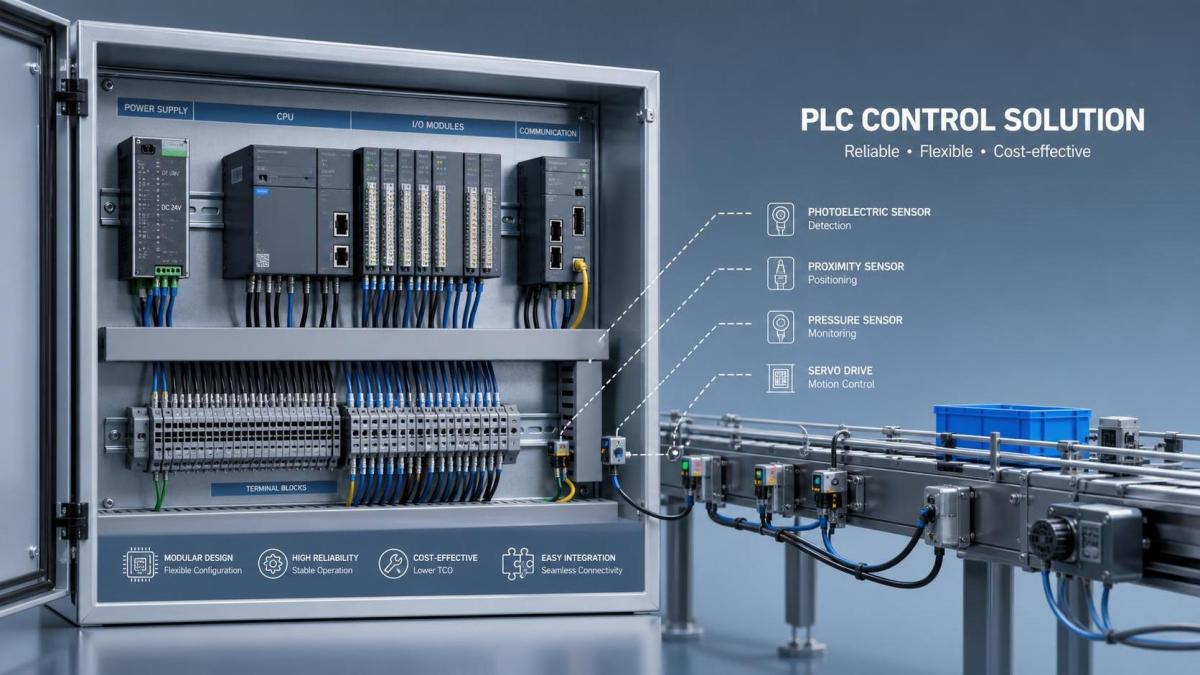
PLC cost usually looks simple at first glance. Then the project moves from controller selection to full system scope, and the number changes fast.
That happens because the controller is only one cost layer. Real spending sits across hardware architecture, I/O count, software tools, panel design, engineering hours, and commissioning effort.
In practical sourcing, the better question is not “What is the PLC price?” It is “What will this automation node cost when installed, validated, and maintained?”
This matters across robotics cells, conveyors, packaging lines, machine tools, UAV ground support equipment, and edge-connected sensor networks. The same PLC cost logic appears in each case.
At TechStat Vanguard, the useful approach is always the same: remove marketing language, isolate parameters, and trace cost back to technical requirements. That is where clean purchasing decisions start.
What exactly sits inside total PLC cost?
A practical PLC cost model includes more than the CPU. Most budget overruns appear when one or two missing categories were ignored during early comparison.
The main buckets usually look like this:
- CPU hardware, power supply, rack, communication modules, and memory options.
- Digital and analog I/O modules, remote I/O stations, safety I/O, and spare capacity.
- Programming software, runtime licenses, HMI packages, and protocol libraries.
- Panel assembly, wiring, labeling, terminals, protection devices, and testing.
- Engineering labor for logic design, mapping, simulation, debug, and documentation.
- Integration risk, factory acceptance testing, site commissioning, and future support.
A low entry controller may still produce a high PLC cost if software is licensed per seat, fieldbus support is extra, or analog expansion requires additional racks.
More commonly, the hidden increase comes from engineering time. A platform that is cheaper to buy can be slower to configure, diagnose, or standardize across sites.
A quick comparison table helps expose the real drivers
When comparing vendors, it helps to separate visible line items from the costs that surface during implementation.
How much of PLC cost is really driven by I/O and field architecture?
Often, more than expected. Once signal counts rise, I/O design becomes a larger cost driver than the CPU itself.
Digital inputs are usually straightforward. Analog signals, thermocouples, RTDs, high-speed counters, and safety points change the budget much faster.
Remote I/O can reduce cabinet wiring and installation hours. Yet it may add network hardware, environmental enclosures, and protocol validation work.
This is where many PLC cost estimates drift. Teams count channels, but do not fully price signal conditioning, shielded wiring, grounding strategy, or isolation requirements.
In high-mix environments, leaving 15% to 25% spare I/O is usually cheaper than redesigning the panel six months later. The lowest initial quote is not always the lowest total cost.
The same logic applies in harsh applications. Aerospace support rigs, mobile automation skids, and edge sensor cabinets often require better EMC behavior, shock tolerance, and wider thermal margins.
A useful checkpoint before comparing PLC cost
- List signals by type, not just by total count.
- Confirm whether safety I/O shares the same platform.
- Check remote node distance, enclosure rating, and cable route complexity.
- Reserve expansion space in the rack and panel footprint.
Is software licensing the hidden reason two PLC quotes look similar but behave differently later?
Very often, yes. Two platforms may show a similar hardware price, while total PLC cost separates sharply once software rules are understood.
Some vendors bundle programming tools. Others charge for each development seat, each protocol driver, safety configuration, motion package, or simulation feature.
That difference matters when several sites, system integrators, or maintenance teams need access. What looks economical in a pilot project can become expensive in a multi-line rollout.
There is also a softer cost. A widely adopted software environment can reduce debugging time, training effort, and code reuse friction.
In practical evaluation, ask for the full software stack in writing. Include version control options, backup and restore tools, online edits, remote diagnostics, and long-term firmware compatibility.
TSV’s broader hard-tech view is relevant here. Whether the system supports robotics, machine vision, or industrial gateways, data transparency around software constraints is more valuable than generic feature claims.
Where do integration and commissioning push PLC cost higher than expected?
This usually happens at the interfaces. The PLC itself may be stable, but the project depends on drives, HMIs, SCADA, barcode readers, vision systems, and OEM subsystems speaking cleanly together.
Each interface creates engineering work. Tag mapping, protocol conversion, alarm handling, and test scripts all add hours.
Motion control raises the stakes further. Coordinated axes, safety interlocks, and deterministic timing can move PLC cost well beyond a standard discrete automation project.
Site conditions matter too. Brownfield upgrades usually cost more than greenfield builds because legacy wiring, undocumented logic, and downtime windows compress the schedule.
A realistic quote should separate these items:
- Panel build and bench test.
- Factory acceptance test scope.
- On-site startup days and travel assumptions.
- Interface responsibility by vendor and subsystem.
- Documentation, backups, and training deliverables.
Without that detail, PLC cost appears controlled until the final integration week. That is usually the most expensive time to discover missing scope.
How can you judge whether a higher PLC cost is actually justified?
The answer depends on failure cost, service life, and standardization value. Paying more can be rational when downtime is expensive or qualification demands are strict.
For example, a premium platform may justify itself when it offers stronger diagnostics, better local support, cleaner cybersecurity updates, or easier spare interchange across several facilities.
That is especially true in regulated or technically demanding sectors. Aerospace fixtures, precision machining cells, and high-speed packaging lines often reward stable, well-supported control platforms.
The more reliable way to judge PLC cost is to compare lifecycle exposure, not just invoice totals. A lower-cost PLC that causes longer troubleshooting time may lose its advantage quickly.
A simple decision filter helps:
What are the most common mistakes when estimating PLC cost?
One common mistake is comparing CPU part numbers without matching the application load. That creates false savings and weak comparisons.
Another is ignoring supportability. Lead times, local inventory, firmware continuity, and replacement policy all affect total PLC cost over time.
Some estimates also miss the cost of standards compliance. Safety circuits, EMC design, documentation traceability, and validation steps are not optional in many projects.
Perhaps the biggest error is treating integration risk as someone else’s problem. If interface ownership is vague, cost usually lands somewhere late and expensive.
A better path is to build a cost sheet that mirrors engineering reality. Separate hardware, I/O, licenses, labor, testing, startup, and lifecycle support before comparing offers.
That approach aligns with TSV’s data-first philosophy. Parameters, failure modes, and measurable scope create trust. Marketing descriptions do not.
So what is the smartest next step when evaluating PLC cost?
Start with the application, not the brand list. Define signal types, cycle requirements, protocol needs, environmental conditions, and expansion expectations.
Then request quotes that break PLC cost into transparent sections. A useful comparison should show hardware, I/O, software, engineering, testing, and commissioning separately.
In parallel, check lifecycle factors: spare strategy, support region, lead time resilience, and platform roadmap. Those points often decide whether a low quote remains low.
For complex automation, a benchmark mindset helps. Compare measurable limits, not slogans. Review protocol support, diagnostics depth, and integration history with the same discipline used for any critical hard-tech asset.
The most reliable PLC cost decision is rarely the cheapest line item. It is the one that fits the process, limits hidden work, and stays supportable through the full operating life.
That is the practical standard worth using before the next RFQ, pilot line, or plant-wide control upgrade moves forward.
Search News
Hot Articles
- Carbon Fiber StructuresHow to Specify Aerospace Carbon Fiber Assemblies for Lightweight, Load-Bearing PartsJul 11, 2026
- Machine VisionXiaomi, Alibaba DAMO Academy Drive Open-Source Robotics Model Ecosystem, Lowering Algorithm Development Barriers for Overseas SMEs Adopting Chinese Robotics SolutionsMar 30, 2026
- Cobots & ArmsShanxi 'AI+' Conference Showcases Embodied Intelligence with Multinational Buyer Engagement: Key Industry ImplicationsMar 30, 2026
Popular Tags
Recommended News
 Jul 11, 2026How to Specify Aerospace Carbon Fiber Assemblies for Lightweight, Load-Bearing PartsAerospace carbon fiber assemblies: learn how to specify laminate design, load data, joining methods, and inspection controls for lighter, reliable load-bearing aerospace parts.Elena Rostova (UAV Systems Researcher)
 Mar 30, 2026Xiaomi, Alibaba DAMO Academy Drive Open-Source Robotics Model Ecosystem, Lowering Algorithm Development Barriers for Overseas SMEs Adopting Chinese Robotics SolutionsXiaomi & Alibaba DAMO Academy's open-source robotics models lower algorithm barriers for global SMEs. Boost efficiency in manufacturing, logistics & smart retail with ROS 2 compatible solutions.TSV Data Lab
 Mar 30, 2026Shanxi 'AI+' Conference Showcases Embodied Intelligence with Multinational Buyer Engagement: Key Industry ImplicationsShanxi 'AI+' Conference highlights embodied intelligence with Tesla, Ubtech & Jiantao showcasing multimodal robotics. 40+ global buyers validated tech on-site, creating new B2B channels for industrial automation & AI solutions.Chen Wei (Automation Lead Engineer)
 Mar 30, 2026Zhongguancun Unveils 6G Integrated Sensing-Computing-Intelligence Platform to Empower Embodied Robots for Global Industrial ApplicationsZhongguancun's new 6G platform revolutionizes industrial robotics with <10ms latency, empowering global automotive, logistics & port automation. Discover how this tech boosts China's smart manufacturing exports.TSV Data Lab
 Mar 30, 2026Mech-Mind Tianjin Embodied Intelligence R&D and Production Base Goes Live, Cutting Delivery Time by 20%–30% for Global Customized AMR+Vision SolutionsMech-Mind's Tianjin AMR+Vision production base cuts delivery time by 20%-30% for欧美 & Latin American markets. Discover how this PLd-certified facility accelerates customized robotics solutions for smart manufacturing and logistics.Chen Wei (Automation Lead Engineer)
 Mar 30, 2026Boao Forum Reveals 'Co-evolution of Big and Small Brains' Trend in Humanoid Robots, China's Embodied Intelligence Accelerates Adaptation to Overseas Manufacturing Service ScenariosDiscover how China's humanoid robots, featuring 'Co-evolution of Big and Small Brains,' are revolutionizing global manufacturing. Learn about Embodied Tian Gong 3.0's ISO compliance and overseas deployment at Boao Forum 2026.Chen Wei (Automation Lead Engineer)
 Mar 30, 2026China Railway Industrial Secures Patent for Embodied Robotics in Material Handling, Boosting High-Precision Delivery Capabilities for Overseas Infrastructure and Manufacturing ProjectsChina Railway Industrial's new patent for embodied robotics in material handling boosts high-precision delivery for global infrastructure & manufacturing. Discover how this innovation enhances logistics accuracy in automotive, rail transit & EPC projects.Chen Wei (Automation Lead Engineer)
 Oct 20, 2026KUKA Launches iiQKA.AI Vision to Simplify Industrial Image ProcessingKUKA iiQKA.AI Vision simplifies industrial image processing with controller-based 2D and 3D vision. Explore drag-and-drop setup for vision-guided automation.TSV Data Lab
 Oct 20, 2026Smart Industrial Edge Devices: Key Criteria for Legacy PLC IntegrationChoose smart industrial edge devices for legacy PLC integration. Discover key criteria for compatibility, data quality, security, and reliable collection without disrupting control.TSV Data Lab
 Oct 19, 2026Choosing a Radar Sensor by Application: Range, Resolution, and Field of ViewSimplify radar sensor application based product selection. Compare range, resolution, and field of view to avoid blind spots and choose with confidence. Explore the guide.TSV Data Lab
 Oct 18, 2026Comparing Material Options for Procurement: Specs, Costs, and Supply RisksExplore procurement oriented technical content on material options, specs, costs, and supply risks. Compare alternatives to cut hidden expenses and make confident sourcing decisions.Dr. Marcus Vance
 Oct 17, 20265-Axis CNC Positioning Accuracy: How to Interpret ISO 230-2 Test ResultsAssess 5 axis CNC machining positioning accuracy with ISO 230-2. Learn to interpret repeatability, reversal error, and test conditions to compare suppliers and make confident acceptance decisions.Dr. Marcus Vance
 Oct 16, 2026Choosing a Rugged Edge AI Box Supplier: Thermal Tests and Lifecycle SupportChoose a rugged edge AI box supplier with proven thermal performance and reliable lifecycle support. Discover the tests and commitments to verify before you buy.TSV Data Lab
 Oct 15, 2026R&D Cost Reduction Services: How to Evaluate Fees, Savings, and ROIEvaluate R&D cost reduction services with confidence. Compare fees, verify savings, and calculate ROI without compromising performance. Discover how to choose a provider that delivers real value.Chen Wei (Automation Lead Engineer)
 Oct 19, 2026How Do You Verify That Precision Machined Parts Meet Tolerances?Master precision machining tolerance verification with the right tools, datum setups, and acceptance rules. Learn how to validate parts confidently and reduce costly inspection errors.Dr. Marcus Vance
 Oct 18, 2026What Should an AS9100 Machining Supplier Checklist Include?Build an AS9100 machining supplier checklist that verifies capability, traceability, inspection, and outsourced processes. Discover what to check before approving your next aerospace supplier.Dr. Marcus Vance
 Oct 17, 2026How Should You Interpret Industrial Robot Repeatability Specs?Decode industrial robot repeatability specifications, understand ISO 9283 test conditions, and avoid costly selection mistakes. Learn how to verify performance for your process.Chen Wei (Automation Lead Engineer)
 Oct 16, 2026How Can You Fairly Compare MTBF Across Industrial Servo Motors?Make a fair industrial servo motor MTBF comparison with matched operating profiles, failure criteria, and confidence bounds. Discover how to assess reliability beyond advertised numbers.Chen Wei (Automation Lead Engineer)
 Oct 15, 2026How Should You Compare TechStat Vanguard 5-Axis CNC Tolerances?TechStat Vanguard 5-axis CNC tolerance comparison: learn how to verify part accuracy, assess inspection evidence, and choose suppliers that reliably meet your drawing requirements.Dr. Marcus Vance
 Oct 14, 2026Drone Frame Composites: Carbon Fiber vs. Fiberglass for Weight and StiffnessExplore drone structural materials composites: compare carbon fiber and fiberglass for weight, stiffness, cost, and antenna compatibility. Find the right material for your drone frame.Elena Rostova (UAV Systems Researcher)
 Oct 13, 2026Smart Cameras vs. PC-Based Machine Vision: Which Fits High-Speed Inspection?This industrial product comparison for machine vision weighs smart cameras vs. PC-based systems on latency, throughput, and cost. Discover your best fit for high-speed inspection.TSV Data Lab
 Oct 12, 2026How to Verify RoHS Compliance in Industrial Sensing Systems Before DeploymentRoHS compliant sensing systems: learn how to verify materials, supplier declarations, testing, and configuration controls before industrial deployment.TSV Data Lab
 Oct 11, 2026How Procurement-Oriented Content Taxonomy Improves B2B Buying JourneysProcurement-oriented content taxonomy streamlines B2B buying journeys with clearer evidence, supplier comparisons, risk visibility, and faster approvals.TSV Data Lab
 Oct 10, 2026How to Select a Machine Performance Monitoring Platform for OEE and Downtime ReductionMachine performance monitoring platform selection guide: validate machine states, OEE data, downtime reasons, integrations, and scalability to reduce losses with confidence.TSV Data Lab